Accelerate IT operations with AI-driven Automation
Automation in IT operations enable agility, resilience, and operational excellence, paving the way for organizations to adapt swiftly to changing environments, deliver superior services, and achieve sustainable success in today's dynamic digital landscape.
Driving Innovation with Next-gen Application Management
Next-generation application management fueled by AIOps is revolutionizing how organizations monitor performance, modernize applications, and manage the entire application lifecycle.
AI-powered Analytics: Transforming Data into Actionable Insights
AIOps and analytics foster a culture of continuous improvement by providing organizations with actionable intelligence to optimize workflows, enhance service quality, and align IT operations with business goals.
Apple and Android have long represented two contrasting approaches to mobile technology. Apple thrives in a closed, tightly controlled ecosystem, where hardware and software work in lockstep. With limited device variations and synchronized updates, the experience remains consistent across its user base. As of June 2025, over 81% of iPhones released in the past four years were running iOS 17, according to Apple’s developer data – giving developers a predictable, uniform foundation for building and testing apps.
Android, by contrast, is built on openness and scale. It powers over 3.9 billion devices worldwide across more than 1,300 manufacturers, from flagship models like the Samsung Galaxy S24 Ultra and Google Pixel 9 Pro to budget phones still running Android 9 or 10. This flexibility drives innovation and affordability across markets, yet it also introduces one persistent challenge: Android fragmentation.
Android Fragmentation refers to the coexistence of multiple Android versions, device configurations, and manufacturer interfaces in active use. Google’s 2024 data showed Android 13 as the most common version, followed by Android 12 and 14, while older versions like Android 10 and 11 still held notable market share. By mid-2025, Android 14 had taken the lead, with Android 15 beginning its rollout. Such dispersion forces developers to build, test, and optimize across a wide, unpredictable range of environments.
This diversity is both Android’s greatest strength and its cost of freedom. It empowers billions of users and fuels global innovation, yet it demands thoughtful engineering, intelligent automation, and continuous optimization to deliver consistent performance. Understanding what fragmentation is, why it exists, and how to effectively mitigate its impact is now fundamental to building resilient, scalable Android solutions in 2025 and beyond.
What is Android Fragmentation
Android fragmentation refers to the diversity and lack of uniformity across Android devices and operating system versions. Unlike a single-curated environment, Android’s ecosystem includes a huge variety of OS versions, OEM customizations, hardware configurations, and form factors.
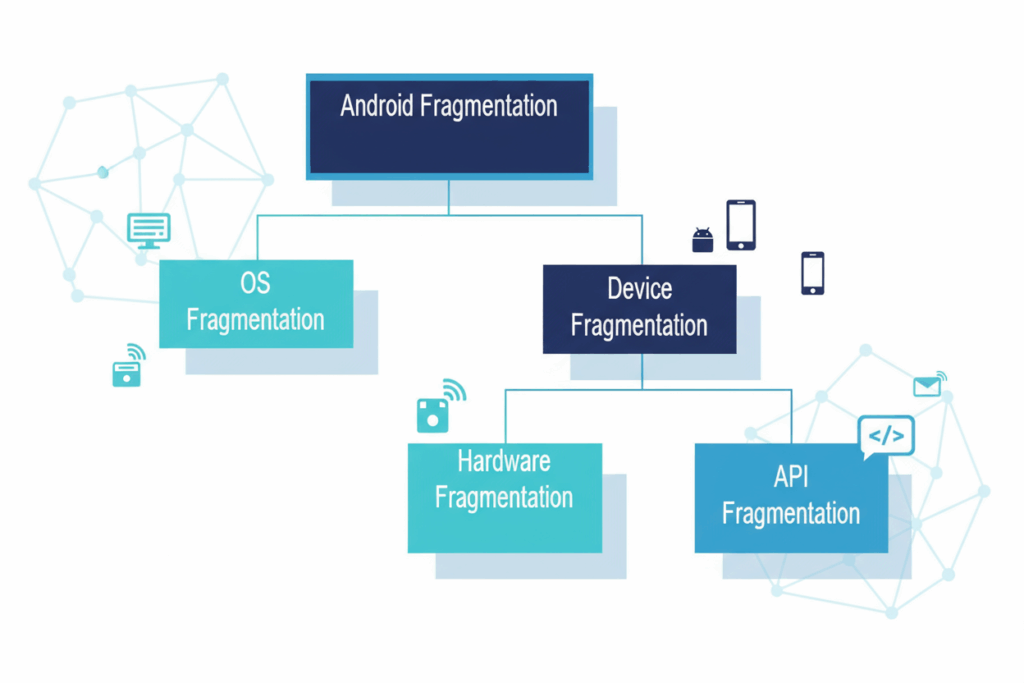
To understand this better, Android fragmentation can be broadly divided into three categories:
- OS Fragmentation – Different Android versions running on devices
- Device Fragmentation – Variations in hardware and APIs across OEMs
- API Fragmentation – Differences in software behavior and API levels
Here’s a simple visual representation of how Android fragmentation is categorized:
According to StatCounter research, Android still dominates global mobile OS share (around 70–75% in recent counts), which means fragmentation isn’t niche: it’s everywhere and matters to nearly every app with a global or diverse audience.
Don’t Miss Out on this Read: Application Testing 101: Everything You Need to Know in 2025
Causes of Android Fragmentation
Fragmentation is the product of several structural realities of the Android ecosystem:
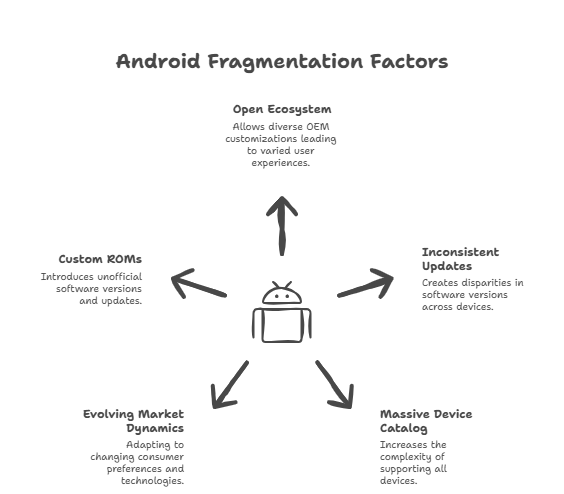
1. Open ecosystem & OEM customization
Android’s greatest strength is also its root cause of fragmentation. Google releases Android as an open-source operating system, giving manufacturers freedom to adapt to their own devices, regions, and market segments. Each OEM adds its own features, modifies system behavior, and sets its own cadence for updates. Carriers and regional partners then layer their own software, creating diversity that leads to wide variability in performance and compatibility.
2. Inconsistent Update Policies
Device makers have different approaches to software maintenance. Some provide Android and security updates for several years, while others stop after a single major version. This uneven policy landscape causes users to remain on older Android versions long after newer ones are released. In 2025, Google confirmed that Chrome version 139 and above would no longer update on Android 8 and 9 devices, signaling how legacy platforms lose access to modern functionality over time. Developers must decide whether to maintain backward compatibility or encourage users to upgrade.
3. The Massive Device Catalog
The Android ecosystem comprises thousands of active device models from more than 1,300 manufacturers. Each comes with unique specifications – screen sizes, chipsets, memory configurations, and sensor layouts. This diversity benefits consumers but complicates development and testing. Every new form factor introduces another variable that developers must test, optimize, and support.
4. Rapidly Evolving Market Dynamics
Android’s fast release cycle keeps innovation moving, but it also accelerates fragmentation. New OS versions and evolving Google Play policy requirements push developers to target updated API levels. By the second half of 2025, new apps and updates on Google Play are expected to comply with modern API targets. This modernization effort often reveals bugs and inconsistencies on older devices, especially when new APIs interact with outdated runtimes.
5. Custom ROMs and Aftermarket Updates
Enthusiasts install custom ROMs (LineageOS, etc.) which may change behaviors or introduce features that your QA lab doesn’t include. Still, these ecosystems show how fragmented the landscape can be in practice.
Business Impact of Android Fragmentation
Fragmentation doesn’t just complicate development – it has measurable business and engineering costs.
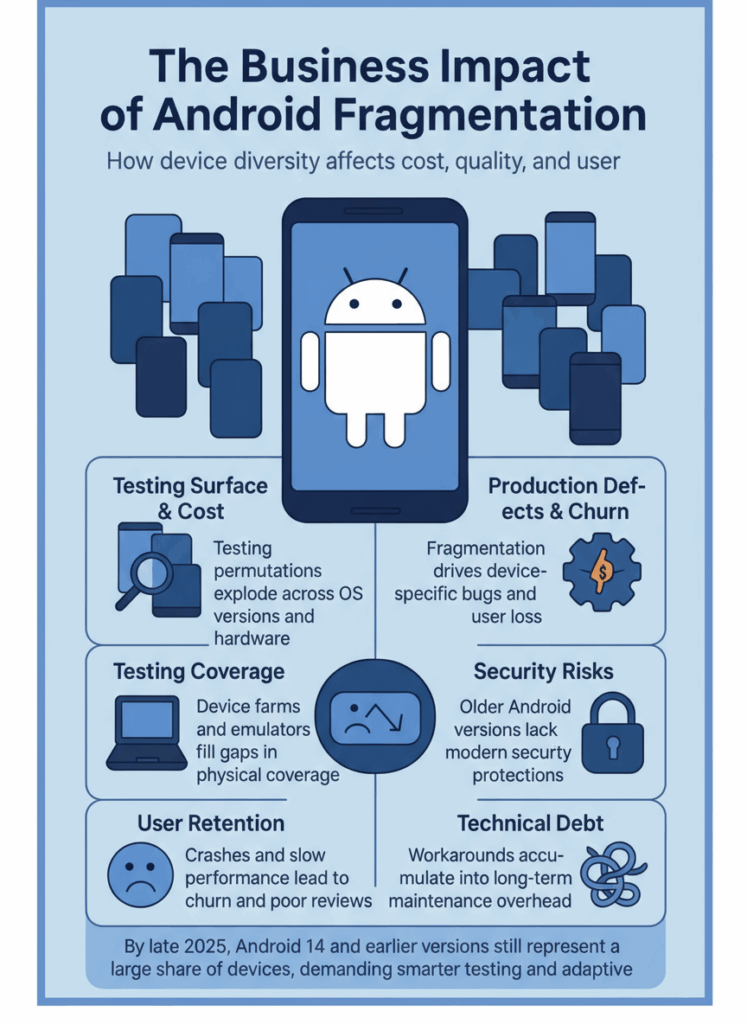
1. Increased testing surface & cost
Every combination of OS version, OEM skin, screen size, and hardware variant multiplies testing permutations. Organizations spend more on device farms, manual QA, and edge-case debugging. Recent industry analyses and QA benchmarks show that addressing device fragmentation is a leading category of testing overhead in 2024–2025.
2. More production defects and user churn
Fragmentation increases the likelihood of device-specific defects that leak to production. Even a small percentage of affected users can translate to higher churn, negative reviews, and support costs. For consumer-facing apps, poor device-specific behavior quickly shows up in app store ratings and social channels.
3. Broader Testing Coverage Needs
Testing every device is impossible, yet skipping coverage invites risk. Many performance issues or visual glitches surface only on specific chipsets or OEM skins. To manage this, teams combine physical device labs, cloud-based testing platforms, and emulators to expand coverage without inflating costs.
4. Security and Compliance Risks
Older Android versions lack the robust security frameworks of newer releases. If a portion of your audience still uses outdated versions, you need mitigation strategies such as stricter network policies, limited permissions, or gating sensitive features.
5. User Experience and Retention Impact
Performance inconsistency and crashes directly affect retention. As of late 2025, Android 15 was gaining share, but Android 14 and earlier versions still represented a large portion of global traffic. This reality demands a data-driven crash management strategy that prioritizes stability across active versions.
6. Engineering complexity and technical debt
Conditional code paths, device workarounds, and special-case QA become long-term technical debt. Every workaround adds maintenance cost and raises the chance of regression when platforms evolve.
How to Deal with Android Fragmentation
Android Fragmentation is not an unsolvable plague – it’s manageable. Here are practical tactics used by successful teams.
1. Define coverage based on data, not fear
Instead of trying to test everything, use analytics to identify the devices, OS versions, and regions that matter most to your users. Prioritize real devices and OS combos by active user percentage and business impact (e.g., revenue-generating markets).
2. Use a blend of emulators, virtual devices, and real-device farms
3. Automate smartly - self-healing tests and prioritization
Automated tests must be resilient. Use self-healing locators, AI-based flakiness detection, and prioritized test suites (smoke/regression vs. deep-compatibility). Modern platforms like Qyrus can auto-select the most impactful tests for a given device/OS combination, reducing wasted runs.
4. Shift-left and shift-right testing
Catch compatibility issues early by integrating compatibility checks into CI (shift-left) and by running synthetic and real-user monitoring (RUM) in production (shift-right). This combination surfaces edge cases before they affect many users.
5. Feature flags and progressive rollouts
Use feature flags to gate new features to a controlled subset of devices or users. Progressive rollouts let you limit exposure to risky device segments and gather diagnostics before a full launch.
6. Monitor and roll back quickly
Robust monitoring and crash aggregation keyed by device model and OS help you detect device-specific regressions quickly. Pair monitoring with automation that can roll back a release or scale down a feature flag when anomalies spike.
7. Partner with platform and OEMs when necessary
For high-value enterprise apps that must run on specific OEM fleets, deeper collaboration with OEM partners (testing programs, certification) may be warranted.
Best Practices for Handling Mobile Fragmentation
Below are repeatable practices that make fragmentation manageable as a continuous process rather than a one-off project.
- Maintain a prioritized device matrix – dynamic, updated from telemetry. Include regional priorities, revenue impact, and user sessions per device model.
- Test real devices for critical paths – login, payments, onboarding, offline flows, and push notifications should hit real hardware during release cycles.
- Invest in automation that’s built for diversity – codeless or AI-assisted automation (self-healing locators, visual validation, cross-device orchestration) reduces brittle scripts and maintenance cost. With Quinnox’s Agentic AI Platform, Qyrus, and approaches like Intelligent Quality (IQ) with Shift Smart Framework, emphasize codeless and AI-driven approaches that increase coverage while cutting maintenance.
- Adopt observability by device – crash, performance, and UX telemetry by device model + OS let you triage effectively. Visualize errors by device to make prioritization decisions.
- Keep minimum supported OS versions reasonable – dropping support for very old versions reduces testing burden. Communicate thoughtfully and provide migration guidance for users on legacy devices.
- Run periodic compatibility sprints – for each major OS release, allocate time for compatibility testing across your prioritized matrix. Some issues only surface after an ecosystem update.
- Leverage community knowledge – blogs, OEM release notes, and communities (XDA, LineageOS discussions, vendor forums) sometimes highlight systemic issues quickly. Use them as early warning signs.
How Quinnox helps You to deal with Android Fragmentation?
If you want a practical, enterprise-grade solution to manage fragmentation at scale, Quinnox’s Shift SMART with Intelligent Quality (IQ) framework and Agentic-AI Platform, Qyrus offer capabilities specifically designed for the problem.
What Quinnox brings to the table
- Data-driven device prioritization: IQ helps teams build a prioritized device matrix using real user telemetry, business impact signals, and market distributions – so you test what matters first.
- AI-powered test generation & self-healing: Qyrus automates test creation and uses AI to make tests resilient to UI and API changes – reducing brittle scripts and ongoing maintenance. This is especially powerful when OEM updates or OS behaviors change unexpectedly.
- Unified orchestration for Mobile, Web, API: Fragmentation isn’t just mobile; bugs surface across touchpoints. Qyrus orchestrates cross-channel tests, so you validate full user flows across devices and backends in one go.
- Real device cloud & analytics: Integrations with device farms and built-in analytics let you catch device-specific regressions and prioritize fixes by impact. Qyrus claims significant gains in coverage and reductions in test-build time and defects.
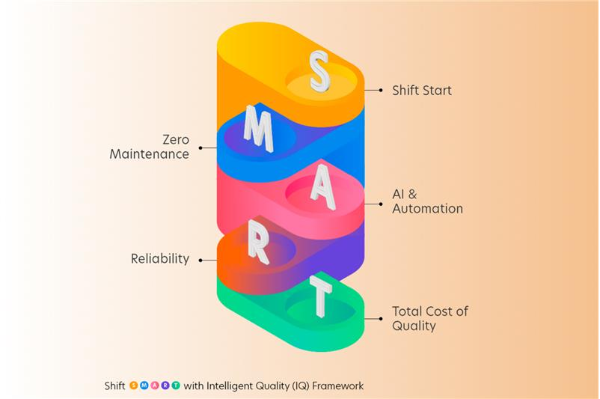
- Shift SMART framework: Quinnox’s Shift SMART approach (Shift Start, Zero Maintenance, AI & Automation, Reliability, Total Cost of Quality) is explicitly tailored to reduce the cost and effort of testing diverse device ecosystems and cut production defects.
A pragmatic example
Imagine a banking app serving multiple emerging markets where low-cost Android devices dominate. Quinnox’s Intelligent Quality approach would analyze session data, recommend a device matrix focused on those exact models, generate self-healing tests for critical flows (login, KYC, payments), and run prioritized test sets across a device cloud. When an unexpected OEM update changes background behavior, AI-driven flakiness detection flags the issue, and analytics show the exact device cohort affected – enabling a targeted fix and a limited rollback via feature flag instead of a costly full-product revert.
Conclusion
Android fragmentation is real, persistent, and historically unavoidable. But it’s not a death sentence for product velocity or quality. The right combination of data-led prioritization, resilient automation, real-device testing, and observability transforms fragmentation from a gigantic, amorphous risk into a set of manageable, prioritized engineering tasks.
Companies that adopt modern testing platforms and AI-powered quality frameworks – and treat fragmentation as a continuous engineering concern, not a one-time QA checkbox – consistently deliver better user experiences, faster releases, and lower support costs. If your team still treats fragmentation as “someone else’s problem,” start with the device telemetry and a prioritized matrix – you’ll be surprised how much ROI you can unlock with focused coverage and smarter automation.
For teams wrestling with fragmentation at scale, Quinnox and Qyrus provide pragmatic tools (AI test generation, self-healing scripts, unified orchestration, and device-aware analytics) to turn fragmentation into a solved operational concern rather than an ongoing crisis.
So, why wait? Get in touch with our experts today!
FAQs About Android Fragmentation
It’s evolving. Core Android updates are more rapid, and Google has made strides with modular updates and Project Mainline. However, the proliferation of new form factors (foldables, TVs) and many OEMs mean fragmentation remains a practical challenge. Version adoption varies by market – always check current distribution data for your priority regions.
Testing top devices is a good start, but critical flows (payments, authentication, offline behavior) should be validated on a broader set that reflects your user base. Use telemetry to guide this list — the “top 10” for global reach may differ greatly by country.
Emulators are excellent for early development and CI smoke tests, but they can’t catch hardware-specific issues (camera, sensors, memory pressure, OEM memory management). Real-device testing is a must for critical user journeys.
The cost varies by organization and product complexity. Industry reports and QA benchmarks indicate fragmentation is one of the top drivers of testing overhead. Smarter automation and prioritized device matrices can reduce costs substantially – Quinnox claim up to 35–50% reductions in certain QA spend metrics.
Start with data-driven prioritization: collect device & OS telemetry from your users, map it to business impact, and build a prioritized device matrix. From there, automate critical-path tests and add real-device runs for high-impact devices.