Accelerate IT operations with AI-driven Automation
Automation in IT operations enable agility, resilience, and operational excellence, paving the way for organizations to adapt swiftly to changing environments, deliver superior services, and achieve sustainable success in today's dynamic digital landscape.
Driving Innovation with Next-gen Application Management
Next-generation application management fueled by AIOps is revolutionizing how organizations monitor performance, modernize applications, and manage the entire application lifecycle.
AI-powered Analytics: Transforming Data into Actionable Insights
AIOps and analytics foster a culture of continuous improvement by providing organizations with actionable intelligence to optimize workflows, enhance service quality, and align IT operations with business goals.
Every enterprise eventually reaches a moment when its legacy systems stop supporting growth and start defining its limits.
Product launches take longer. Data initiatives stall before delivering value. Security exceptions multiply.
On paper, everything still “works.”
In reality, the business is slowing down.
Because legacy systems rarely fail in dramatic, headline-making outages. They fail quietly. Gradually. They extend decision cycles, increase hidden dependencies, inflate operating costs, and erode strategic flexibility.
That’s what makes them dangerous.
By the time downtime, escalating expenses, or systemic risk become obvious, the organization has already lost time, money, and competitive ground.
A disciplined legacy system assessment changes that dynamic. It surfaces invisible constraints, quantifies accumulated risk, and transforms modernization from a reactive expense into a proactive strategic advantage.
What Is Legacy System Assessment?
A legacy system assessment is a structured, multidimensional evaluation of an organization’s existing application and platform landscape to determine its current health, business relevance, risk exposure, and modernization potential.
Unlike a narrow legacy software audit, a comprehensive assessment examines systems through five interconnected lenses:
- Business criticality and value contribution
- Architectural fitness and technical debt
- Data integrity, governance, and interoperability
- Security, compliance, and operational risk
- Economic efficiency and scalability
The goal is not simply to catalog applications, but to understand how each system supports or limits enterprise objectives.
Why a Legacy System Assessment Is Important
A legacy system assessment forces the organization to step back and look at its technology landscape objectively. It answers uncomfortable but necessary questions:
- Which systems are mission-critical versus simply familiar?
- Where is technical debt increasing operational risk?
- How much of the IT budget is spent maintaining the past instead of enabling the future?
- What would actually happen if a key component failed tomorrow?
Let’s further explore some of the key reasons why legacy system assessment is important for any enterprise:
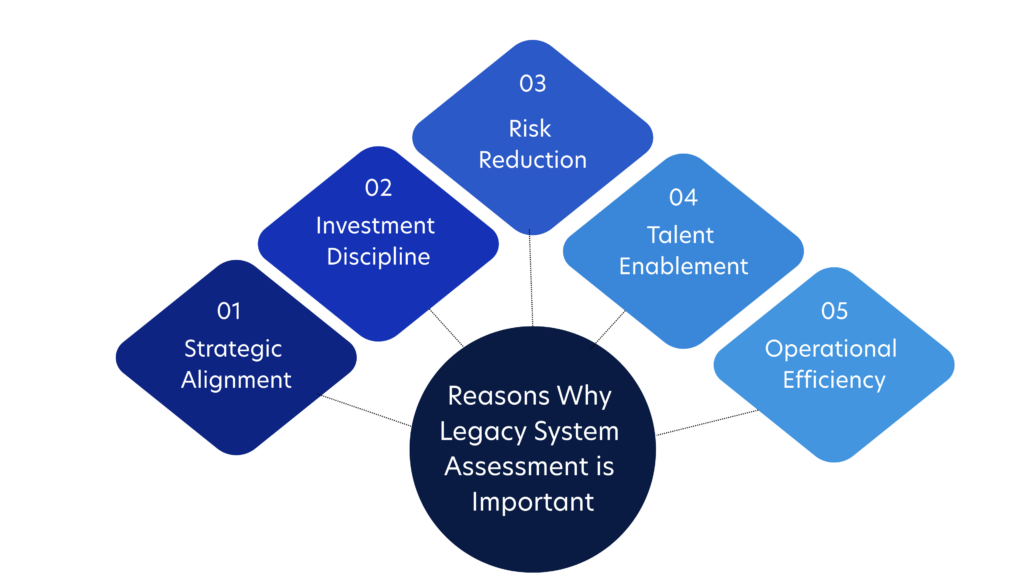
1. Strategic Alignment
Without assessment, technology strategy becomes reactive. With it, leaders can align modernization priorities to growth, customer experience, and regulatory goals.
2. Investment Discipline
Assessment enables leaders to shift from blanket modernization budgets to targeted investments guided by value and risk.
3. Risk Reduction
Unsupported components, fragile integrations, and undocumented dependencies are identified before they trigger outages or compliance issues.
4. Talent Enablement
Clear visibility into system futures improves workforce planning and reduces reliance on shrinking skill pools.
5. Operational Efficiency
Over time, outdated platforms often require manual workarounds, duplicate data entry, repetitive troubleshooting, and excessive maintenance effort. These hidden inefficiencies drain productivity and inflate costs without always being visible in financial reports.
By systematically evaluating system performance, integration gaps, and process dependencies, organizations can streamline workflows, eliminate redundant tasks, and redirect resources toward higher-value initiatives.
The Hidden Cost of Not Assessing Legacy Systems
One of the most underestimated aspects of legacy environments is not their visible maintenance cost, but the opportunity cost they silently impose on the enterprise.
When leaders delay or shortcut assessment of legacy software, three compounding costs emerge.
First, strategic optionality shrinks.
Every new business initiative whether entering a new market, launching a digital product, or embedding AI into operations becomes constrained by what existing systems can support. Over time, strategy begins to conform to system limitations rather than market opportunity.
Second, execution velocity degrades.
Teams learn to work around legacy constraints using manual processes, shadow IT, and brittle integrations. While this may preserve short-term continuity, it significantly slows delivery cycles and increases operational fragility.
Third, risk accumulates invisibly.
Unsupported components, undocumented dependencies, and inconsistent security controls compound year over year. By the time risk becomes visible often through outages or audit findings the remediation effort is exponentially higher.
A disciplined legacy system assessment surfaces these hidden costs early, allowing leaders to intervene before constraints become crises.
Why “Lift-and-Shift” Thinking Fails Without Assessment
Many organizations equate modernization with migration particularly cloud migration. While infrastructure migration can deliver short-term cost or scalability benefits, lift-and-shift approaches frequently fail to deliver strategic value when they are not preceded by a rigorous assessment of legacy software.
Without assessment:
- Inefficient architectures are replicated in new environments
- Poorly governed data is moved faster but not improved
- Monolithic designs are rehosted instead of decomposed
- Operational complexity increases instead of decreasing
This leads to a paradox: modern platforms hosting legacy problems.
A legacy system assessment reframes modernization from where systems run to how systems create value. It enables leaders to decide which applications should be re-architected, which should be replaced with SaaS, which should be stabilized, and which should be retired altogether.
This clarity is foundational to any effective legacy application modernization strategy.
Key Steps in a Legacy System Assessment
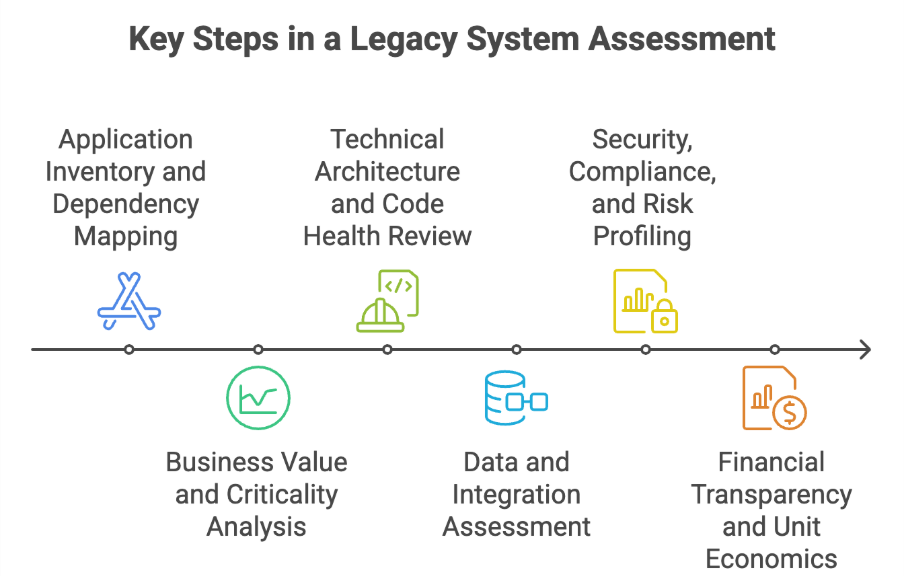
1. Application Inventory and Dependency Mapping
Create a complete, validated inventory of applications, interfaces, and dependencies. Shadow systems must be surfaced explicitly.
2. Business Value and Criticality Analysis
Assess how each system supports revenue, customer experience, compliance, and differentiation.
3. Technical Architecture and Code Health Review
Evaluate modularity, scalability, resilience, and technical debt accumulation.
4. Data and Integration Assessment
Review data quality, ownership, latency, and interoperability across systems.
5. Security, Compliance, and Risk Profiling
Identify vulnerabilities, regulatory gaps, and operational exposure.
6. Financial Transparency and Unit Economics
One of the most powerful but often missing dimensions of a legacy system assessment is financial clarity.
Beyond total cost of ownership, leaders should understand:
- Cost per transaction
- Cost per customer served
- Cost per business capability enabled
- Cost of change versus cost of failure
This lens shifts the conversation from “Is this system expensive?” to “Is this system economically rational?”
When unit economics are made visible, prioritization becomes objective. Systems that consume disproportionate resources relative to business value naturally rise to the top of modernization roadmaps.
Challenges of the Legacy System Assessment
A legacy system assessment sounds straightforward in theory: evaluate what you have, identify risks, define a path forward. In practice, it is rarely that simple.
Below are the most common challenges organizations encounter:
1. Limited System Visibility
Many enterprises lack a complete and accurate inventory of their applications, integrations, and data flows. Over time, systems evolve through patches, workarounds, and undocumented customizations. What appears to be a single platform often depends on multiple hidden components, making risk difficult to measure.
2. Knowledge Gaps and Documentation Issues
Original architects and developers may no longer be with the organization. Documentation is often outdated, incomplete, or missing entirely. Critical operational knowledge may reside with a small number of employees, creating both assessment difficulty and key-person risk.
3. Hidden Dependencies
Legacy environments tend to accumulate tightly coupled integrations. A minor change in one system can unintentionally disrupt another. Identifying these interdependencies requires time, technical expertise, and sometimes reverse engineering.
4. Organizational Resistance
Legacy systems are frequently tied to long-standing processes and team ownership. Stakeholders may feel defensive about platforms they have supported for years. An objective legacy system assessment can surface uncomfortable truths, which may slow collaboration if not handled carefully.
5. Difficulty Quantifying Risk and Value
Age alone does not determine whether a system should be modernized. The real challenge lies in evaluating total cost of ownership, security exposure, compliance risk, scalability limits, and strategic alignment. Without clear metrics, legacy modernization decisions become subjective.
6. Budget Constraints and Fear of Large Investments
Some organizations avoid deep assessments out of concern that findings will demand immediate, large-scale replacement. This hesitation can narrow the scope of the evaluation and delay necessary action, increasing long-term costs.
7. Prioritization Complexity
Rarely can every legacy system be addressed at once. After risks are identified, leaders must decide what to retire, refactor, replace, or temporarily maintain. Establishing a clear, phased roadmap is often one of the most challenging parts of the process.
Legacy System Assessment Checklist
A legacy system assessment is most effective when it moves beyond general impressions and follows a structured evaluation. The goal should not be simply to label systems as “old” or “outdated,” but to understand their real impact on risk, cost, and business agility.
Use the checklist below as a practical framework to guide a thorough and objective review.
1. Business Criticality
- What core business functions depend on this system?
- How would operations be affected if it were unavailable for a day? A week?
- Is the system directly tied to revenue generation or regulatory obligations?
Understanding business criticality prevents overreacting to low-impact systems while overlooking high-risk ones.
2. Technical Health
- Is the underlying technology still supported by the vendor?
- Are updates and patches regularly applied?
- How stable is the system under current workloads?
- Does performance degrade during peak demand?
A technically “stable” system may still be approaching obsolescence if vendor support or skilled talent is disappearing.
3. Security and Compliance Risk
- Does the system meet current cybersecurity standards?
- Are there known vulnerabilities or recurring security exceptions?
- Does it comply with industry or regional regulatory requirements?
- Is sensitive data encrypted and properly access-controlled?
Legacy platforms often introduce hidden exposure because they were built for an earlier threat landscape.
4. Integration and Dependencies
- What other systems rely on this platform?
- Are integrations standardized or built through custom scripts and manual processes?
- How easily can data be extracted or shared?
Complex, tightly coupled integrations increase modernization difficulty and amplify operational risk.
5. Total Cost of Ownership
- What are the annual maintenance and support costs?
- How much internal effort is spent troubleshooting or maintaining it?
- Are licensing fees increasing?
- How does its cost compare to modern alternatives?
Maintenance-heavy systems can quietly consume budget that could otherwise fund innovation.
6. Scalability and Flexibility
- Can the system scale with projected growth?
- Does it support cloud integration, APIs, or modern development practices?
- How quickly can new features or changes be implemented?
If enhancements require excessive effort, the system may be constraining business agility.
7. Talent and Support Availability
- Are skilled professionals still available to maintain this technology?
- Is knowledge concentrated within a few individuals?
- How difficult is it to recruit or train new team members?
Talent risk is often overlooked until a key employee leaves.
8. Modernization Path Options
Your application modernization strategy should answer these before taking the final call:
- Can the system be upgraded, refactored, replatformed, or replaced?
- Would incremental modernization reduce risk without full replacement?
- What are the estimated timelines and transition risks?
9. Strategic Alignment
- Does this system support the organization’s long-term digital strategy?
- Is it enabling innovation or slowing it down?
- Would keeping it limit future transformation initiatives?
Technology should enable strategy, not constrain it.
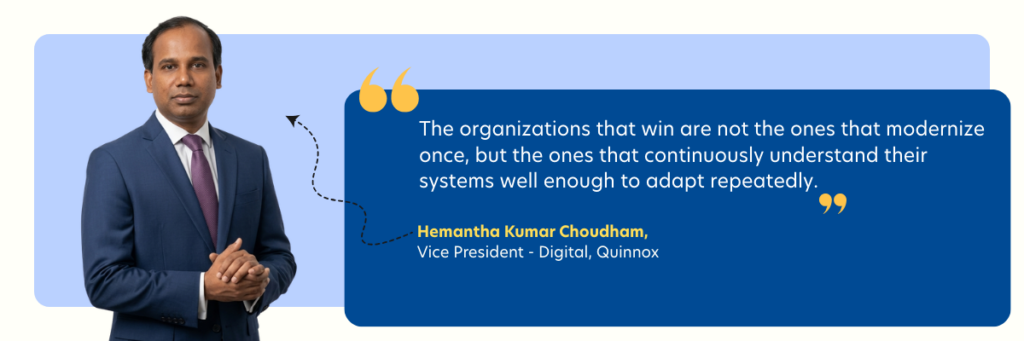
Example of Legacy System Assessment Checklist
Here are a few examples of generic questions that might be on your checklist when you assess legacy software.
Conclusion
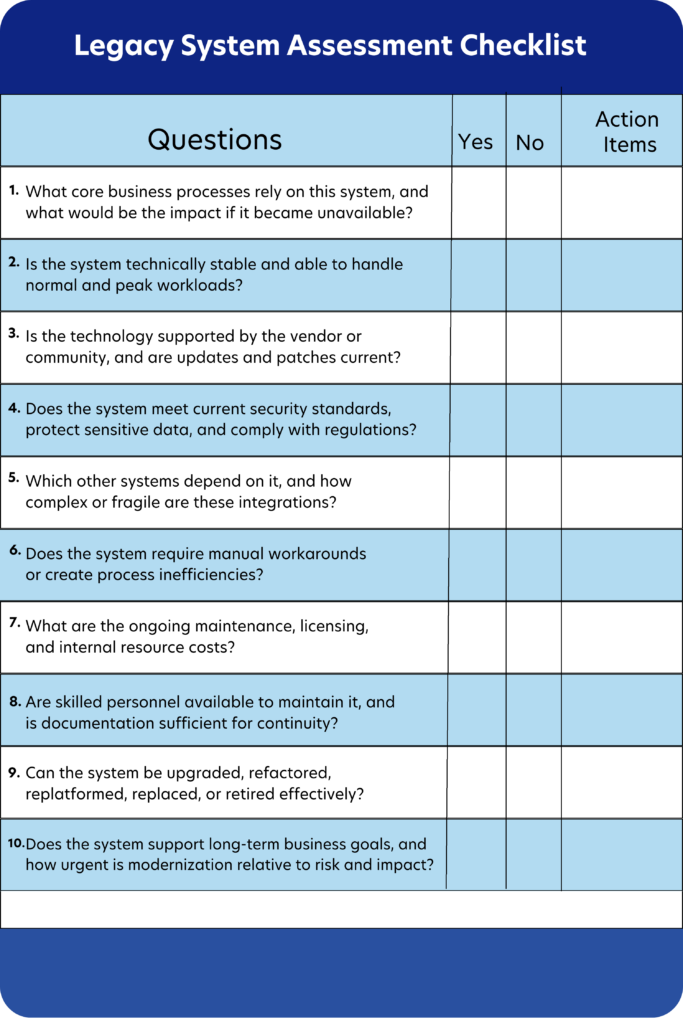
Modernization today is no longer just about replacing outdated platforms. It is about building adaptive, intelligent ecosystems that scale with the business. It is about aligning technology investments with measurable outcomes. And increasingly, it is about leveraging AI not as a feature, but as a foundational capability.
If your organization is ready to move from maintaining the past to engineering the future, now is the time to act.
Connect with Everforth Quinnox experts to begin your legacy modernization journey powered by an AI-driven Services-as-Software (SaS) model that accelerates transformation, reduces risk, and delivers continuous value.

Vice President, Marketing, Everforth Quinnox
FAQs on Legacy System Assessment
A legacy system assessment is a structured evaluation of existing applications to understand business value, technical health, risk exposure, and modernization potential. It helps leaders make informed decisions about modernization, replacement, stabilization, or retirement.
Key steps include application inventory, business criticality analysis, technical and data assessment, security risk evaluation, and financial unit economics analysis to guide modernization prioritization.
If your organization struggles with slow releases, high maintenance costs, integration issues, or rising operational risk, it is a strong indicator that you need to assess legacy software systematically.
Depending on scope and complexity, a legacy system assessment typically takes 6–12 weeks, with phased insights available earlier to support immediate decision-making.