In every organization, knowledge is power, but not all knowledge is visible. While documented processes and manuals exist, a significant portion of expertise lives in employees’ heads. This “tribal knowledge” – the intuition, shortcuts, and unwritten rules that teams rely on, is both invaluable and fragile.
Organizations that fail to capture it risk inefficiency, errors, and repeated reinvention of solutions. At the same time, the rise of AI and enterprise intelligence tools presents a unique opportunity: transforming hidden expertise into structured, actionable insights.
Knowledge graphs, is a technology that doesn’t just store information, but maps the relationships, patterns, and context behind it, bridges the gap between human expertise and AI-driven decision-making.
What is Tribal Knowledge & Why It’s Hard to Capture
Tribal knowledge refers to the unwritten, experiential know-how that exists within teams. It includes:
- Process shortcuts and best practices learned through experience
- Context-specific problem-solving insights
- Customer or vendor preferences known only to a few
Why it’s hard to capture:
- Tacit nature: Much of this knowledge is intuitive and difficult to articulate.
- Fragmented storage: Even when documented, it’s often scattered across emails, spreadsheets, chat threads, or siloed systems.
- Human turnover: When an employee leaves, their expertise often leaves with them.
- Rapid change: Procedures evolve faster than documentation can keep up, making existing records obsolete.
The Impact:
Consider an IT support team handling complex SAP incidents. One senior engineer knows the exact steps to resolve recurring ticket clusters, but that knowledge is undocumented. When that engineer is unavailable, MTTR spikes, tickets pile up, and SLA compliance suffers.
This scenario illustrates the real cost of tribal knowledge: operational delays, frustrated customers, and lost institutional memory.
In fact, a Gartner survey found that 46% of employees struggle to find the information they need to do their jobs effectively, pinpointing a direct problem that knowledge codification can address.
Knowledge Graphs: a New Approach to Enterprise Intelligence
A knowledge graph is a structured network of entities (nodes) and relationships (edges) enriched with attributes. Unlike traditional databases, which store data in tables, knowledge graphs capture meaning and context, enabling both humans and AI systems to discover insights and make decisions.
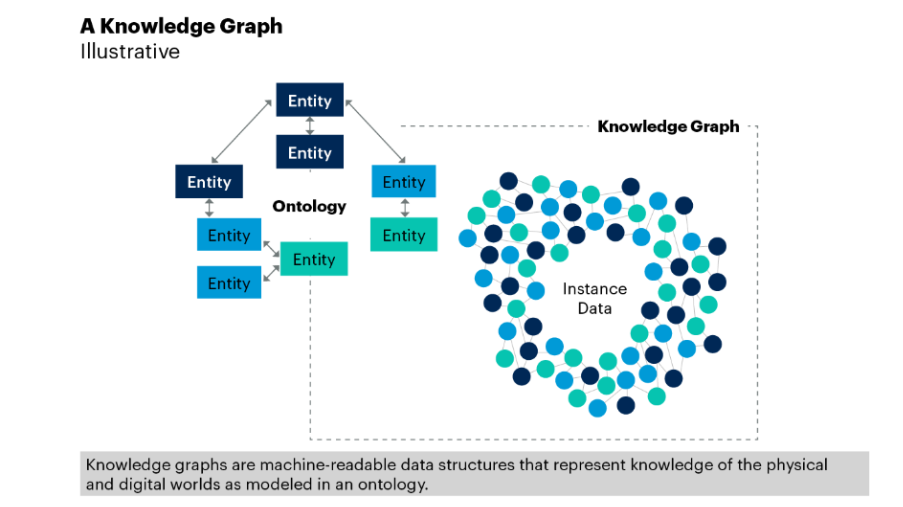
Source: Gartner
Why it matters for tribal knowledge:
- Converts tacit knowledge into structured, queryable information
- Maps workflows, processes, and dependencies across teams and systems
- Supports AI reasoning for predictive insights and automation
Infusing the AI Power
Our intelligent Application Management (iAM) platform Qinfinite’s Knowledge Graph operationalizes knowledge graphs in your entire IT landscape. It codifies tribal knowledge from support teams, creating a living, AI-enabled map of the enterprise IT. For example:
- Auto-triage: Past incident patterns helps instant ticket categorization
- Root-cause insights: Relationships between recurring issues are surfaced automatically
- Knowledge democratization: Critical expertise becomes accessible to all team members, reducing reliance on a few key people
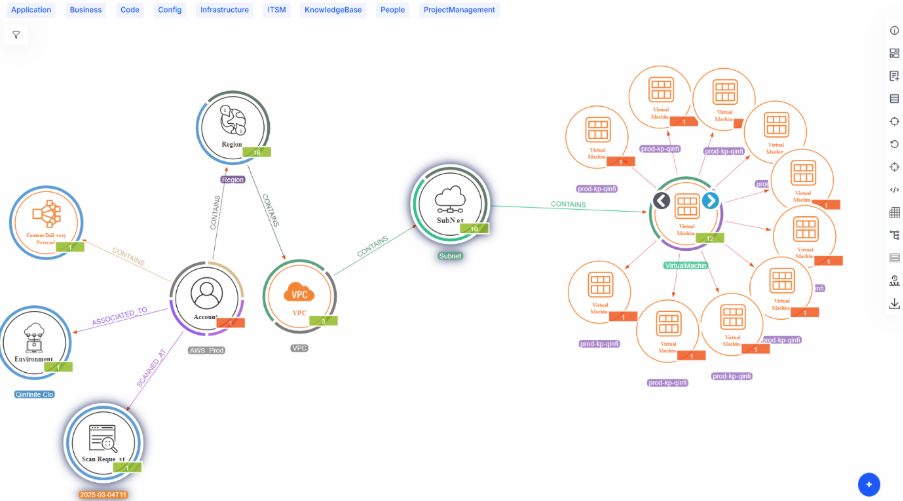
Caption: Knowledge graph in Qinfinite
For enterprises looking to extend this concept further, explore Enterprise Knowledge Graphs to understand how cross-functional intelligence can transform IT operations.

Arun CR, Head of Engineering, Qinfinite
"Tribal knowledge has always been the hidden engine of enterprise success. With Qinfinite’s knowledge graphs, we’re not just preserving that expertise, we’re amplifying it across teams, turning individual insights into collective intelligence that drives faster decisions and better outcomes."
The Human Element: How People Shape the Graph
Knowledge graphs are powerful, but their success depends on human participation to –
- Validate relationships: ensuring connections reflect real-world processes
- Provide context: adding nuances AI alone cannot infer
- Maintain currency: updating workflows as systems and processes evolve
The goal is collaboration, not replacement. By combining human expertise with AI reasoning, enterprises can capture both structured knowledge and tacit insights.
Example: In ITSM, junior engineers can follow AI-suggested resolutions based on historical patterns, while senior engineers continue to refine and validate the graph, ensuring knowledge remains accurate and actionable.
From Tribal Knowledge to Collective Intelligence
Once tribal knowledge is codified in a knowledge graph, organizations achieve collective intelligence:
- Reduced MTTR: Automated insights allow faster incident resolution
- Faster onboarding: New employees access expertise without lengthy shadowing
- Cross-team alignment: Dependencies and workflows are visible across functions
- Scalable learning: Knowledge grows organically as the graph expands
Implementation Tips: Building a Human-Centric Knowledge Graph
- Identify Critical Knowledge Areas: Focus on high-impact processes or recurring pain points.
- Map Entities and Relationships: Define systems, workflows, stakeholders, and dependencies.
- Integrate AI Reasoning: Use AI to surface patterns, suggest resolutions, and recommend process improvements.
- Encourage Continuous Human Input: Ensure SMEs validate and update the graph regularly.
- Measure Impact: Track metrics like MTTR, resolution accuracy, and knowledge adoption rates.
If that sounds like a lot of work, it is! Platforms like Qinfinite offer pre-built knowledge graphs, making enterprise adoption faster and more effective.
Conclusion
Tribal knowledge has always been a silent driver of enterprise performance, but left unmanaged, it creates risk. Knowledge graphs, when human-centered and AI-augmented, convert this hidden expertise into collective intelligence.
By codifying insights, capturing relationships, and empowering teams with platforms like Qinfinite, organizations can democratize knowledge, accelerate decision-making, and future-proof operations.
In 2026 and beyond, the companies that harness the human side of knowledge graphs will not only preserve institutional wisdom but also transform it into a strategic asset.
FAQs
No. Knowledge graphs capture structured and semi-structured knowledge effectively, but tacit judgment and situational intuition still rely on human expertise.
Qinfinite’s Knowledge Graph codifies incident patterns, SOPs, and workflows into a living knowledge graph, making expertise accessible, automatable, and scalable across IT and enterprise operations.
No. AI complements human judgment automates routine insights, and surfaces patterns, while humans validate, contextualize, and maintain the knowledge.
Prediction of issues, faster issue resolution, improved onboarding, cross-team collaboration, knowledge democratization, and reduced dependency on individual experts.
Focus on high-value knowledge areas, map entities and relationships, integrate AI for reasoning, and ensure continuous human validation.