In March 2015, Apple experienced a 12-hour global outage across its retail and online stores – an incident that erased $25 million in revenue in half a day. Just over a year later, in August 2016, a five-hour power failure at one of Delta Airlines’ key operations centers triggered the cancellation of 2,000 flights and cost the airline an estimated $150 million. Then came March 2019: a single platform outage cost Facebook approximately $90 million in under 14 hours.
These aren’t anomalies. They’re warnings.
Systems fail. Infrastructure breaks. Incidents happen. And, despite heavy investments in monitoring, alerts, and recovery plans, incident management teams often remains reactive, diagnosing failures only after users are impacted.
Fault injection within chaos engineering flips this script. It’s not random sabotage; it’s a precise and controlled way to surface vulnerabilities before they escalate. By deliberately provoking faults like network delays, server crashes, or resource exhaustion organizations can observe how their infrastructure responds under pressure, validate recovery protocols, and ultimately harden their defenses.
What is Fault Injection?
Fault injection is a controlled approach where errors, glitches, or failures are purposefully introduced into a system to observe how it behaves under stress. Think of it as a fire drill but for software and hardware infrastructures. Instead of waiting for an unplanned outage or system collapse, engineers simulate faults ranging from simple delays and resource exhaustion to complex network partitions or hardware malfunctions. The goal? To reveal hidden weaknesses, evaluate recovery mechanisms, and enhance overall system robustness.
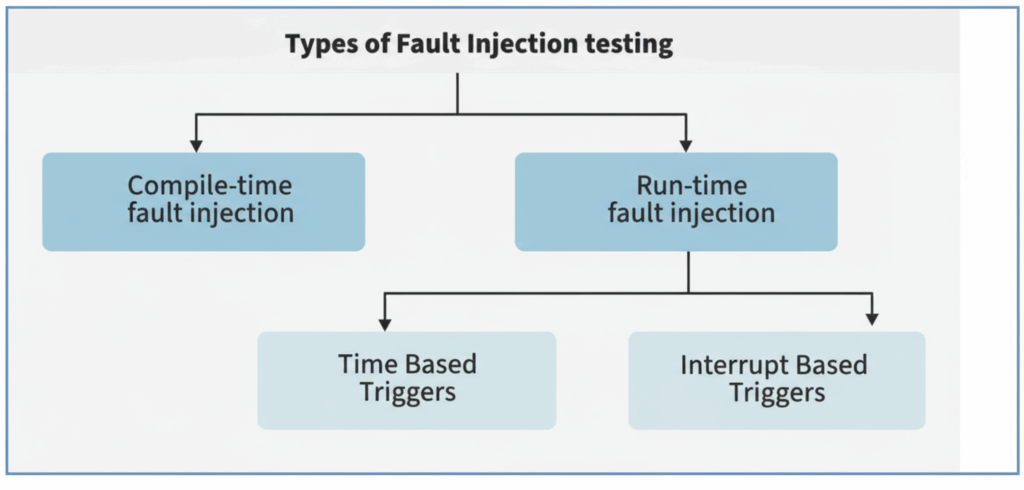
Unlike traditional testing that checks if a system meets its expected functions, fault injection testing intentionally disrupts normal operations to challenge assumptions and uncover blind spots. It’s about proactively learning from failure before failure learns from you.
How Fault Injection Works

At its core, fault injection operates by targeting specific system components or processes and injecting anomalies while monitoring the resulting behavior. This could take many forms:
- Hardware Faults: Simulating disk failures, CPU throttling, or power interruptions.
- Software Faults: Inducing memory leaks, thread deadlocks, or database connection drops.
Network Faults: Introducing latency spikes, packet loss, or network partitions
These injections are carefully orchestrated using specialized tools and frameworks that allow precise timing, scale, and scope control. For example, an engineer might deliberately delay API responses to test timeout handling or abruptly kill a service process to observe failover behaviors.
The data collected during these experiments such as logs, metrics, and system state snapshots are then analyzed to identify weak points and improvement opportunities. Over multiple iterations, systems become battle-hardened, with better fallback strategies, improved error handling, and a culture that embraces failure as a learning opportunity.
Key Benefits of Fault Injection for System Resilience
Fault injection offers a treasure trove of advantages that transcend simple bug detection:
Unmasking the Invisible Fault Lines
Systems often hide their most dangerous weaknesses in blind spots – situations so rare or convoluted that conventional testing never triggers them. Fault injection deliberately conjures these elusive conditions, like subtle timing issues or rare hardware glitches, bringing to light vulnerabilities that quietly lurk beneath surface stability. By simulating these atypical failures, teams gain a rare glimpse into scenarios where the system might otherwise falter unnoticed, enabling fixes before disaster strikes.
Putting Recovery Plans through a Reality Check
Failover protocols, retry logics, alerting mechanisms are some of those safety nets that may sound good on paper but only reveal their true worth under pressure. Fault injection forces these recovery processes out of the shadows, verifying whether they perform as designed when the system is under pressure. This real-world validation uncovers gaps in recovery workflows, allowing teams to fine-tune their response and prevent cascading failures.
Building Rock-Solid Confidence in Stability
Uncertainty breeds hesitation. Knowing that a system can endure injected faults without collapsing injects a sense of confidence that ripples through development, operations, and leadership alike. This assurance reduces the fear of deploying new features or scaling services, because resilience has been battle-tested, not assumed. As a result, downtime shrinks, and the user experience remains smooth, even under unexpected duress.
Sharpening the Reflexes for Incident Handling
When chaos strikes, swift diagnosis and remediation are vital. Fault injection experiments double as rehearsals for incident response, exposing teams to realistic failure conditions in a low-stakes environment. These rehearsals enhance the ability to quickly pinpoint issues, understand root causes, and execute recovery steps.
Cultivating a Mindset That Sees Opportunity in Disorder
Perhaps the most profound benefit lies in cultural transformation. Instead of fearing faults and outages, organizations learn to embrace them as opportunities for insight and improvement. Fault injection fosters an environment where controlled chaos is not an enemy, but a mentor guiding teams to build systems that don’t just survive failure but grow stronger because of it. This shift from reactive firefighting to proactive resilience-building redefines the relationship between people and technology, setting the stage for innovation rooted in robustness.
Best Practices for Running Fault Injection Experiments
Conducting fault injection effectively demands thoughtful planning and disciplined execution. Here are some guiding principles:
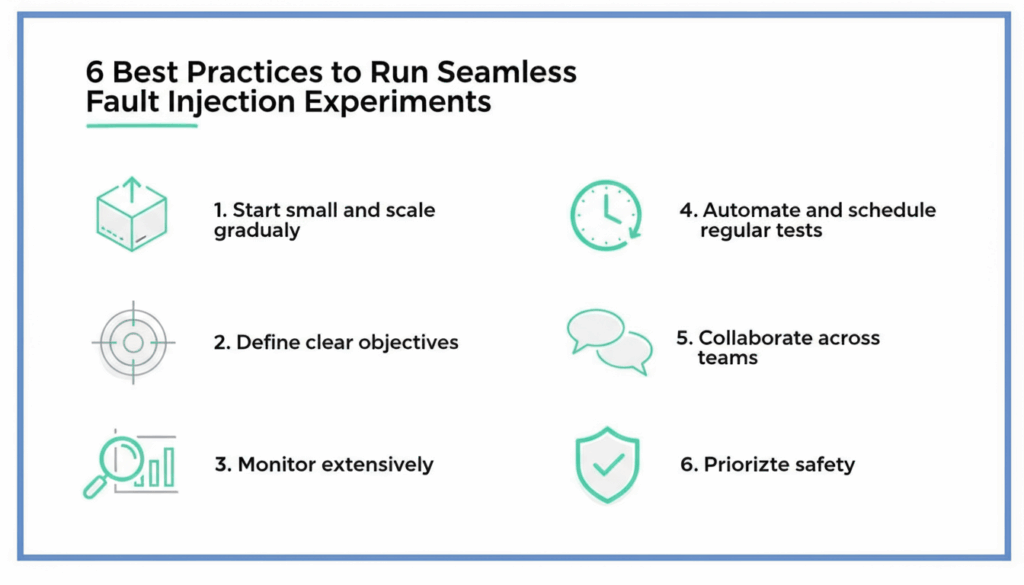
Start Small and Scale Gradually:
Begin with non-critical components or isolated environments before expanding to full production systems. This “baby steps” method lets teams observe system reactions in a safe space and learn how to interpret fault signals. As confidence builds and understanding deepens, gradually expand experiments to larger components and eventually production. This phased progression minimizes risk while maximizing learning.
Define Clear Objectives:
Know what you want to test – be it latency tolerance, failover readiness, or data consistency. Defining these targets upfront channels efforts into actionable insights, making the process more efficient and the outcomes more valuable.
Monitor Extensively:
Faults can manifest in subtle, interconnected ways, making comprehensive monitoring essential. Utilize an array of observability tools such as tracing, metrics, logs, and alerting systems to capture every nuance of system behavior during an experiment. The richer the data, the better you can pinpoint root causes and gauge the true impact of injected faults. Neglecting this step risks missing critical signals buried in the noise.
Automate and Schedule Regular Tests:
Resilience is a continuous journey, not a one-off event. Embedding fault injection into regular testing cycles, ideally through automation, keeps systems battle-ready even as they evolve. Scheduling fault injection tests periodically, whether as part of CI/CD pipelines or maintenance windows, ensures that resilience is integrated into the development lifecycle rather than an afterthought.
Collaborate Across Teams:
Fault injection experiments cut across multiple domains including code, infrastructure, user experience, and business outcomes. Engaging developers, system operators, QA teams, and business leaders ensures that experiments align with broader organizational priorities and that insights get shared widely. This cross-pollination not only broadens perspective but also fosters a shared sense of ownership over system resilience.
Prioritize Safety:
Rapid rollback plans and fail-safes should be in place before any fault hits the system, providing a safety net that lets teams experiment boldly without reckless risk. Hence, setting strict limits on the scope of experiments such as restricting blast radius to a small subset of users or services can help contain damage if things spiral unexpectedly.
Adhering to these best practices helps organizations extract maximum value from fault injection while minimizing risks.
Challenges and Risks Users Need to Address
While fault injection offers substantial benefits, it’s not without pitfalls:
- Potential for Service Disruption: Injected faults may cause outages or degrade user experience if not carefully controlled.
- Complexity in Execution: Designing realistic failure scenarios that reflect production conditions requires deep system knowledge.
- Data Integrity Concerns: Some faults could corrupt data if safeguards aren’t in place.
- Cultural Resistance: Teams unfamiliar with chaos engineering may fear breaking things or doubt its value.
- Tooling Limitations: Not all environments support sophisticated fault injection without custom development.
Mitigating these challenges involves a combination of rigorous planning, education, strong monitoring, and incremental adoption.
Steps to Implement Fault Injection in Your Organization
For teams ready to embark on this transformative journey, a structured roadmap can smooth the path:
- Assess Current Resilience Posture: Understand existing failure modes, recovery processes, and pain points.
- Build a Cross-Functional Resilience Team: Gather diverse expertise from development, operations, security, and business units.
- Select Appropriate Tools and Frameworks: Choose platforms that integrate well with your technology stack and observability infrastructure.
- Design Targeted Fault Scenarios: Align experiments with business-critical processes and known vulnerabilities.
- Run Controlled Experiments: Begin in staging environments, analyze outcomes, and refine approaches.
- Gradually Introduce Production Testing: Start with low-impact services, progressively increasing scope as confidence grows.
- Document and Share Learnings: Maintain a knowledge base and conduct post-mortems to continuously improve.
- Embed Fault Injection into CI/CD Pipelines: Automate resilience testing as part of regular development cycles.
- Foster a Culture of Resilience: Promote openness about failures and continuous learning.
Conclusion
Fault injection stands as a cornerstone of chaos engineering, turning the fear of failure into an opportunity for growth. By systematically provoking faults and studying system responses, organizations can uncover hidden flaws, validate recovery strategies, and cultivate a resilient digital infrastructure. While challenges exist, a disciplined approach grounded in clear goals, safety measures, and cultural readiness enables teams to harness the full power of fault injection.
Quinnox’s intelligent Application Management (iAM) platform Qinfinite elevates this practice by offering a comprehensive suite of chaos engineering capabilities designed to seamlessly integrate fault injection into your operational workflows. Leveraging our chaos engineering services, organizations gain access to intelligent automation, granular control over experiment scope, and real-time observability, empowering teams to execute fault injection with precision and confidence.
Ready to build systems that don’t just survive chaos but thrive within it? Schedule a personalized session or request for a FREE demo to experience how Qinfinite can benefit your business.
FAQ’s Related to Fault Injection
Fault injection is a deliberate process of introducing controlled disruptions or failures into a system to test how it behaves under adverse conditions. Within chaos engineering, it involves simulating faults such as network latency, service crashes, or resource exhaustion to expose hidden weaknesses and observe recovery mechanisms in action.
Fault injection helps organizations move beyond assumptions and guesswork by validating how their systems respond to unexpected conditions. It reveals vulnerabilities that traditional testing often overlooks, ensuring that failover strategies, alerts, and recovery workflows work as intended in the wild. By proactively uncovering and addressing weaknesses, fault injection minimizes downtime, reduces incident impact, and builds confidence that systems can withstand real-world chaos.
Common techniques include introducing artificial network delays or packet loss to simulate connectivity issues, forcibly terminating services or containers to mimic crashes, consuming system resources like CPU or memory to test degradation under load, and injecting errors into data flows to validate error handling. These tactics can be applied individually or in combination, depending on the resilience goals and the system’s architecture.
Fault injection requires careful planning to avoid unintended damage, especially in production environments. Challenges include defining safe experiment boundaries (blast radius), ensuring comprehensive monitoring to capture the effects of faults, aligning cross-functional teams around testing objectives, and integrating fault injection into existing development and operations workflows.
Traditional testing typically verifies that software behaves correctly under expected conditions—checking whether features work as designed. Fault injection, by contrast, deliberately introduces abnormal conditions and failures to test how systems handle stress, degradation, and unexpected scenarios. It emphasizes resilience and recovery over correctness, aiming to prepare systems for real-world unpredictability rather than just validating functionality.