Introduction
Traditional testing often creates a widening gap between development and delivery. Teams find themselves locked in long regression cycles, delaying releases while defects slip through the cracks. Test coverage rarely keeps up with the pace of change, and QA teams end up firefighting rather than preventing issues. When this happens, quality stops being a shared goal and becomes an afterthought. As a result, business leaders start to see testing as an obstacle rather than a safeguard, and that perception undermines confidence in the entire release process.
This growing tension is what makes test automation essential. It’s not simply about running scripts faster; it’s about reimagining how quality fits into modern software delivery. Automation introduces consistency, repeatability, and speed where manual methods falter. It enables teams to validate complex systems continuously, respond to change instantly, and release with confidence.
What Is Test Automation
At its heart, test automation is the systematic use of software tools, frameworks and processes to automate the execution of test cases, validation of expected results, and reporting of outcomes across the full software ecosystem of a large organization. Unlike point-automation for a single product, test automation addresses the breadth and depth of applications: legacy systems, API layers, web/mobile front-ends, integrations, performance and security, across multiple teams and geographies.

Key characteristics define the “enterprise” nature:
- Scale: Hundreds to thousands of test cases, multiple product lines, frequent releases.
- Diversity: Different technology stacks, multiple environments (on-premises, cloud, hybrid), third-party integrations.
- Governance and standards: Common frameworks, reuse of assets, reporting across business units and silos.
- Continuous and rapid delivery: Aligning with CI/CD, DevOps, agile pipelines—automation must plug into the flow rather than remain a separate phase.
- Business-focus: Automating not just functional tests but business flows, compliance tests, non-functional tests (performance, security, accessibility).
- Maintainability: Due to change frequency, automation assets must be maintainable, reusable and self-sustaining.
In effect, test automation shifts from a tactical, individual project exercise to a strategic, organisational asset, enabling the enterprise to deliver with speed, quality and reliability.
Benefits of Test Automation
When automation is implemented with the right intent and structure, its impact on an enterprise goes far beyond faster test execution. It reshapes how organizations think about quality, delivery, and even collaboration between teams. The benefits are both tangible and cultural – a shift from reactive quality control to proactive quality engineering.
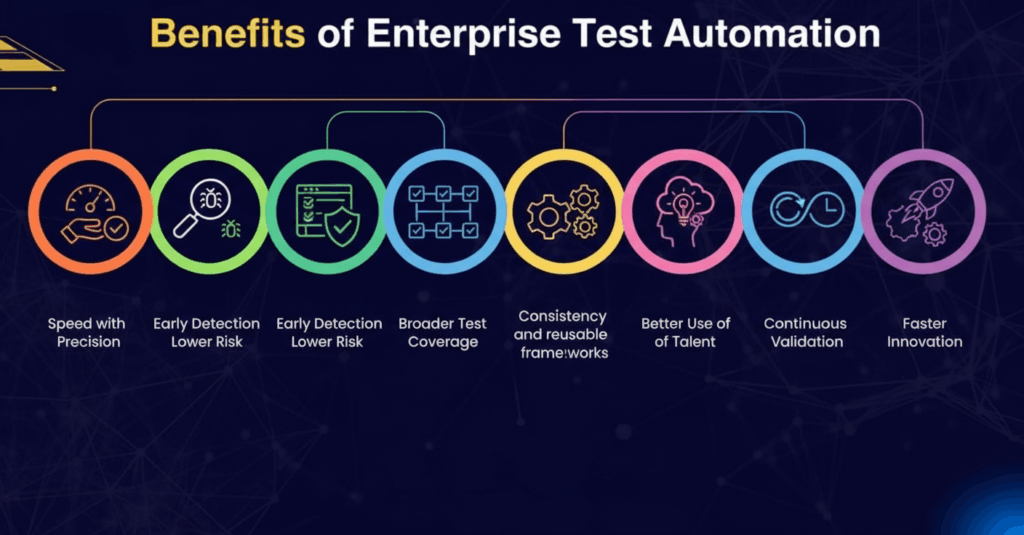
Speed with precision
Automation eliminates the fatigue and inconsistency of repetitive manual testing, ensuring that each validation is performed with the same level of precision, every single time. For organizations aiming for weekly or even daily releases, this capability becomes a cornerstone of agility.
Early detection, lower risk
In traditional testing, many defects surface late in the development cycle often after integration or during user acceptance testing. At that stage, fixes are expensive and disruptive. Automation, when embedded early in the pipeline, flips that equation.
Continuous automated tests catch defects as soon as they appear, allowing teams to fix them before they cascade into larger issues. This early feedback loop reduces risk and stabilizes the entire release process. Over time, it also helps build a stronger sense of trust between development, QA, and business stakeholders.
Broader and deeper coverage
Enterprises often operate in complex ecosystems consisting of multiple applications, APIs, data streams, and user interfaces all working together. Manual testing can only touch a fraction of this landscape.
Automation expands that reach, covering more scenarios, data combinations, and edge cases than any human-led effort could sustain. It allows teams to validate not just what’s visible on the surface, but also the intricate backend interactions that often hide critical bugs. In doing so, it raises the overall reliability of enterprise systems.
Consistency and repeatability
Test automation ensures consistency and repeatability by executing tests in a controlled, uniform, and code-driven manner free from human variability. Automated scripts follow the same steps, use identical data, and run under standardized environments every time, guaranteeing that test results reflect actual software behavior rather than tester differences. This structured, repeatable approach allows teams to compare outcomes across builds and releases with confidence, ensuring reliability, accuracy, and stability in enterprise-scale quality assurance.
Better use of talent
When repetitive validation is automated, human testers are free to focus on the kind of work machines can’t do well including exploratory testing, usability assessment, creative problem-solving. Automation further helps QA professionals shift their attention to understanding business risks, designing smarter tests, and collaborating more closely with developers and product teams, leading to higher productivity and more engaged, empowered teams.
Continuous validation for continuous delivery
In a DevOps-driven world, where enterprise test software moves from commit to production in hours, quality can’t be a phase at the end of the cycle – it must be continuous. Automation makes that possible.
Integrated into CI/CD pipelines, automated tests run with every build or deployment, providing near-real-time insight into system stability. This continuous validation keeps releases flowing smoothly and ensures that quality keeps pace with speed.
Cost efficiency over time
While automation does require upfront investment in tools, frameworks, and skills, the long-term financial return is undeniable. Reusable scripts, reduced manual effort, fewer production incidents, and faster turnaround all contribute to lower overall costs.
The more automation assets mature and expand, the more they pay back. Over time, enterprises that automate effectively spend less on testing and gain more from every release.
Stronger confidence and faster innovation
Perhaps the most underappreciated benefit of automation is psychological. When teams trust their testing ecosystem, they release faster, experiment more boldly, and innovate without fear.
Automation provides the safety net that allows development teams to push boundaries. Leaders can make data-driven decisions based on real-time quality metrics rather than gut instinct. That confidence translates directly into market responsiveness and customer satisfaction.
Challenges of Test Automation
While the benefits of test automation promises speed and precision, achieving that vision is rarely straightforward. Many organizations discover that scaling automation across complex systems brings different set of hurdles—technical, organizational, and strategic. Understanding these challenges of test automation upfront helps prevent automation from becoming another costly initiative that fails to deliver its intended value.
High Initial Investment
Building an enterprise-grade automation ecosystem requires significant upfront effort and funding. It’s not just about purchasing tools; it involves designing frameworks, setting up infrastructure, building pipelines, training teams, and integrating with existing systems. Many organizations underestimate this initial lift, leading to half-built automation projects that never reach full adoption.
Continuous Maintenance
Every code change, UI tweak, or API update can break existing scripts. Over time, maintaining these assets can consume as much effort as creating them, especially without a disciplined governance model. Hence, without regular maintenance cycles, test suites quickly become unreliable, producing false failures that erode trust among development teams.
Tool and Technology Fragmentation
Enterprises often use a patchwork of systems including legacy applications, cloud platforms, microservices, and third-party integrations. No single automation tool fits all of these environments perfectly. As a result, teams juggle multiple frameworks, creating silos of automation that don’t communicate well with each other. This fragmentation makes reporting, governance, and collaboration more complicated than they should be.
Test Data and Environment Instability
Reliable test results depend on consistent data and stable environments, both of which are difficult to achieve at enterprise scale. Realistic data may be locked behind compliance rules, while shared environments are often overwritten by parallel teams. These inconsistencies lead to unreliable results, wasted test cycles, and frustration among testers who can’t distinguish real defects from environment issues.
Skill Gaps and Change Resistance
Automation requires a different skill set than traditional testing such as scripting, framework design, CI/CD integration, and data management. Many QA teams are still catching up to this shift.
Beyond the technical skills, there’s also cultural resistance. Some teams view automation as a threat rather than an enabler, while others struggle to align around a shared automation strategy. Without the right mindset and talent, even the best tools fall short.
Prioritization and Scope Control
Not every test should be automated, yet many enterprises attempt to automate everything at once. This “automate-all” mentality spreads resources thin and creates bloated test suites that are hard to manage. Hence, the challenge lies in strategic prioritization, focusing automation on high-risk, high-value areas that deliver measurable returns, while leaving exploratory or one-off scenarios to manual testing.
Scalability and Performance Constraints
As automation coverage grows so does the need for scalable infrastructure to execute tests quickly. Enterprises with thousands of test cases often struggle with execution time, parallelization limits, and resource bottlenecks. Without careful planning, test runs that were meant to save time can instead slow down the delivery pipeline.
False Positives and Trust Erosion
When automation is poorly designed or executed in unstable environments, it produces inconsistent results that can be false positives or flaky tests. These erode trust in the automation suite. Developers start to ignore test results, reverting to manual checks and bypassing the system altogether. Once that confidence is lost, rebuilding it takes significant effort and credibility.
Measuring ROI and Proving Value
Business leaders want to see measurable ROI, and without strong metrics or visibility, automation teams can struggle to justify their investments. Automation’s benefits are long-term and often indirect, not translating into immediate cost savings, which most leaders fail to understand.
Keeping Pace with Change
Enterprise ecosystems
evolve constantly with new tools, updated frameworks, and shifting release cadences. Keeping automation aligned with these changes is a moving target. What worked last year may already feel outdated today.
Hence, staying current requires continuous learning, adaptation, and reinvention – a reality many teams are unprepared to sustain.
Best Practices for Test Automation
To convert the promise of test automation into real enterprise value, organisations should adhere to a set of proven best practices. Below are key recommendations:
Define a clear strategy and roadmap
Before jumping into scripting, develop an automation strategy aligned with business goals: what to automate, when, how much coverage, what success means (KPIs).
A roadmap should include phases: pilot → scale → optimise. Avoid doing everything at once.
According to best-practice lists: “Start small, then scale.” Ensure alignment with DevOps/CI/CD, release cadence, and business priorities.
Automate the right test cases
Not all tests should be automated. Focus on high-value, high-risk, repetitive, regression-related test cases. Tests that are unstable, rarely run, or require high subjectivity may not be ideal for automation.
Build a scalable, maintainable automation framework
Design the test automation framework so that it can grow with the application landscape:
- Modular architecture, reusable components (e.g., Page Object Model for UI)
- Data-driven, keyword-driven or behaviour-driven approaches
- Clear separation between test logic and data/configuration
- Version control for test assets; treat test code like production code (peer review, documentation)
- Ensuring self-healing or resilient mechanisms: tests adapt when UI changes or API evolves. Framework design makes ongoing maintenance practicable.
Integrate with CI/CD and DevOps pipelines
Automation is most effective when embedded in the release pipeline rather than running manually at the end of a cycle. So, integrate scripts to run on every commit (or nightly), link to build/merge events, provide feedback quickly.
Manage test data and environments effectively
Good environment and data management underpins reliable automation. Establish robust processes for test data creation, maintenance, masking or synthetic data generation especially for compliance/regulation.
Monitor and maintain automation health
Regularly review and prune the automation suite: remove obsolete tests, refactor brittle ones, keep metrics on test execution time, pass/fail rates, flaky test count. Monitor build times and optimise as necessary.
Collaborate across teams
Automation is a cross-team initiative, so ensure that it is not isolated to only QA. The success of your automation efforts depend on collaboration across teams including Dev, QA, business analysts, operations, and release management working together.
Create measurable KPIs and dashboards
Dashboards help stakeholders visualise progress, identify hotspots, and justify investment. Hene make sure to define and track metrics: test execution time, number of tests run, coverage (functional/API/units), defect escape rate, cost of quality, build-to-release time, etc. for transparency and accountability.
Invest in up-skilling and processes
Without the right skill set, your team cannot make test automation a success. So, make sure to train your team in automation design, scripting, test architecture, CI/CD, analytics to enhance their performance.
Scale gradually and continuously optimize
Begin with a pilot or focused area to validate the approach, then expand horizontally to other modules, platforms or geographies. Avoid “big-bang” automation programmes.
Embrace shift-left and shift-right
Quality should not be confined to pre-release. Shift-left means embedding testing early (requirements, unit, API) while shift-right means monitoring in production, feedback loops, user behaviour analysis. This continuous quality mindset ensures enterprise systems remain resilient in live environments.
Ensure automation addresses non-functional aspects
Functional testing alone is not enough. Performance (load, stress), security, reliability, accessibility, cross-platform compatibility are equally important for enterprise systems. Automation must include these aspects, not leave them as manual or ad-hoc. Best practice lists advise including non-functional testing.
Examples of Test Automation
Whether it’s a global bank managing millions of transactions, a retailer synchronizing online and in-store experiences, or an energy company operating critical infrastructure, automation has become a vital enabler of reliability and speed. Below are some real-world scenarios that show how test automation drives transformation across sectors.
Banking and Financial Services
Banks use test automation to validate complex transaction workflows across web, mobile, and core banking systems. Automated regression suites run daily to ensure new features don’t disrupt existing processes like fund transfers or loan approvals. Integration testing between internal systems and external networks (such as SWIFT or UPI) is automated to verify real-time communication under varying load conditions.
Some institutions have also adopted AI-driven automation for fraud detection testing, using data-driven simulations to ensure systems correctly flag suspicious activity without false positives. Automation in this space doesn’t just speed up testing; it ensures compliance, reduces operational risk, and builds confidence in every release.
Retail
For modern retailers, digital reliability directly affects revenue. From browsing and checkout to fulfillment and returns, the customer journey spans multiple touchpoints. Testing each of these manually during rapid product rollouts or seasonal promotions is unfeasible.
Retail organizations use automation to validate end-to-end shopping journeys across devices and browsers. Every UI change, inventory sync, and payment integration is continuously tested through automated pipelines. During high-traffic events like Black Friday, load testing scripts simulate thousands of concurrent users to confirm system stability and responsiveness.
Beyond functional checks, automation also validates personalized recommendations, loyalty programs, and order tracking integrations in real time. By doing so, retailers maintain a consistent brand experience and minimize costly downtimes during critical sales windows.
Manufacturing and Industrial Systems
Manufacturing enterprises face a different kind of challenge: complex ERP systems, supply chain integrations, and industrial IoT platforms that need to stay in sync. Automation here ensures that digital operations and physical processes work seamlessly together.
For instance, automated testing validates data flow between shop-floor machines and ERP systems like SAP. When a sensor reports production output, automated scripts confirm that this data correctly updates inventory and triggers procurement workflows. Further, integration testing between logistics, warehouse management, and production systems ensures that every component of the supply chain reacts instantly to changes.
Utilities
Utilities whether water, electricity, or gas operate in tightly regulated environments where system failure can have far-reaching consequences. Their IT ecosystems often combine legacy control systems with modern digital interfaces and customer-facing portals.
Test automation plays a vital role in verifying the reliability of billing systems, outage management platforms, and customer service applications. Automated test suites simulate real-world usage patterns such as high billing loads at month-end or emergency alert responses during service disruptions.
Testing software also supports compliance reporting by validating data accuracy across systems and generating consistent audit trails. For utilities undergoing digital transformation, this consistency helps bridge old and new technologies without compromising service continuity.
Energy Sector
Energy companies operate some of the most complex systems on the planet – spanning grid management, predictive maintenance, trading platforms, and customer engagement systems. Manual testing in such an environment would be both time-consuming and risky.
Automation ensures that updates to control software or energy trading algorithms perform as intended under all operational scenarios. In renewable energy, automated tests verify real-time data analytics from wind or solar farms, ensuring that output metrics align with predictive models. For energy trading platforms, automation validates transaction accuracy and compliance with market regulations before going live.
Waste Management and Environmental Services
Though less often highlighted, automation is becoming equally transformative in waste management and sustainability sectors. Companies in this space manage diverse technologies from IoT sensors in collection vehicles to customer portals for recycling programs.
Test automation ensures that route-optimization algorithms, billing systems, and environmental reporting tools all function reliably together. Automated tests validate that data from collection sensors flows accurately into analytics dashboards, enabling real-time decision-making about resource allocation or vehicle routing.
How Quinnox IQ Helps in Test Automation
In the enterprise world, automation alone is no longer enough. The real challenge lies in making testing intelligent — capable of adapting, learning, and improving with every release. This is where Quinnox’s AI-powered Intelligent Quality (IQ) testing framework stands apart.

Rather than treating testing as an isolated or reactive activity, IQ weaves intelligence directly into the fabric of the software lifecycle. It blends AI, automation, analytics, and cloud-native design to turn testing into a strategic advantage instead of a procedural checkpoint. At the heart of this approach lies Shift SMART – a framework that brings automation earlier in the delivery cycle, enabling teams to test smarter, not just faster. By embedding IQ across every stage of development, enterprises gain the agility to deliver quality at speed without compromising stability or governance.
The measurable impact is hard to ignore. Organizations using IQ have reported:
- Reduce test build time by 70%
- Cut total Cost of Quality by 50%
- Eliminate costly maintenance issues right from the start
Conclusion
Success arises from viewing automation not as a set of scripts, but as an ecosystem: strategy, process, people, technology and governance. By adopting best practices – selecting the right cases, building maintainable frameworks, integrating with DevOps, collaborating across teams, measuring impact, continuously optimising – organisations can realise automation as a high-return asset rather than a maintenance burden.
Partners such as Quinnox with its IQ-powered software testing solutions helps enterprises leverage advanced frameworks, AI-driven end-to-end testing automation, domain accelerators and governance models to scale automation effectively and see real business impact.
FAQs about Test Automation
Test automation is the use of automated testing frameworks and tools to validate complex software systems across large organizations. It ensures consistent, repeatable, and scalable testing across multiple applications, platforms, and environments, helping enterprises maintain quality while accelerating delivery.
Regular testing tools are often designed for smaller projects or single applications, whereas testing software handles large-scale, interconnected systems. It supports integration across multiple platforms, offering advanced reporting, and scaling to meet the demands of global development teams.
Test software enables large-scale testing by automating repetitive tasks, managing extensive test suites, and integrating with CI/CD pipelines. It also allows parallel execution across multiple environments and provides centralized dashboards for visibility and reporting.
Key benefits include faster release cycles, improved test coverage, reduced human error, cost efficiency, consistent quality, and the ability to scale testing across multiple applications and environments.
Common challenges include high initial investment, test maintenance, integration across diverse systems, skill gaps in automation, flaky tests, and managing test data and environments at scale.