Accelerate IT operations with AI-driven Automation
Automation in IT operations enable agility, resilience, and operational excellence, paving the way for organizations to adapt swiftly to changing environments, deliver superior services, and achieve sustainable success in today's dynamic digital landscape.
Driving Innovation with Next-gen Application Management
Next-generation application management fueled by AIOps is revolutionizing how organizations monitor performance, modernize applications, and manage the entire application lifecycle.
AI-powered Analytics: Transforming Data into Actionable Insights
AIOps and analytics foster a culture of continuous improvement by providing organizations with actionable intelligence to optimize workflows, enhance service quality, and align IT operations with business goals.
Enterprise application services are at an inflection point. What worked for a world of predictable workloads, stable systems, and linear change no longer holds in an environment defined by continuous releases, always-on expectations, and relentless cost pressure. Against this backdrop, Quinnox’s recognition in the HFS Challenger Series: Tear Up Your Tier-1 Playbook – How Quinnox Is Rewiring Enterprise Service Delivery is more than an industry nod – it is a signal that the AMS market itself is being redefined.
HFS identifies Quinnox as a pragmatic challenger in the fast-emerging Services as Software (SaS) market – a category HFS expects to reach $1.5 trillion by 2035. The significance of this recognition lies less in scale or technology ambition, and more in how Quinnox is rethinking the fundamentals of service delivery itself.
What the HFS Challenger Series Represents and Why It Matters
According to HFS Research, the HFS Challenger Series is not a celebration of size, brand recognition, or legacy market share. Instead, it spotlights service providers that are actively challenging orthodoxies – questioning long-standing assumptions about how services should be delivered, priced, and governed.
Being recognized by HFS as a challenger from a pool of highly promising and established competitors means the provider:
- Has a clear point of view on where the services market is headed
- Showcases evidence of operating-model innovation, not just tooling or accelerators
- Demonstrates impact for enterprise clients navigating complexity at scale
For Quinnox, this recognition reinforces its positioning as a provider that is not competing to optimize yesterday’s AMS models but instead reframing what AMS needs to look like in an always-on, continuously changing enterprise environment.
Why People-Heavy AMS Models Are No Longer Sustainable
Traditional AMS models were built on a simple assumption: complexity could be managed by adding more people. For a time, that worked. But today’s enterprise environments no longer behave in predictable, linear ways.
People-heavy AMS struggles because:
- Complexity has outpaced human scalability: Modern application landscapes span cloud, SaaS, legacy, integrations, and continuous change. More people do not automatically mean faster resolution.
- Always-on environments punish latency: Downtime, even minor, carries immediate business impact. Ticket queues and manual triage create friction where none can be afforded.
- Cost predictability erodes over time: FTE-based pricing rewards activity, not throughput or outcomes, leading to cost inflation without commensurate value.
- Accountability becomes diffuse: When dozens of roles touch a single incident, ownership blurs and root causes persist.
Enterprises are not looking for cheaper labor; they are looking for reliability, speed, and clarity at scale.
How Services-as-Software Redefines AMS
Services as Software represents a shift in mindset – from treating AMS as a labor construct to treating it as a system of execution.
Instead of asking, “How many people do we need to run this environment?” the model asks:
- How fast can issues be identified and resolved?
- How visible is work in progress and performance in real time?
- How directly are costs tied to outcomes rather than effort?
By redesigning AMS around throughput, transparency, and outcomes, Services as Software changes the economics and experience of service delivery. Automation, AI, and analytics are not integrated on as enhancements; they are embedded into the way work flows through the system.
The real appeal here is not the technology itself, but the operating-model shift it enables – one that delivers predictability and accountability without forcing enterprises into disruptive, multi-year transformation programs.
Where Quinnox Is Delivering Measurable Gains
Enterprise service delivery is no longer constrained by infrastructure or tooling rather constrained by outdated operating models. As application landscapes grow more complex and business expectations shift toward always-on performance, traditional approaches to Application Management Services (AMS) are struggling to keep up. Simply adding automation or expanding teams is no longer enough.
Quinnox is addressing this challenge by fundamentally rethinking how AMS is designed and delivered. Through a Services-as-Software operating model, Quinnox is rewiring enterprise service delivery to focus on speed, accountability, and outcomes without forcing organizations into disruptive, multi-year transformation programs.
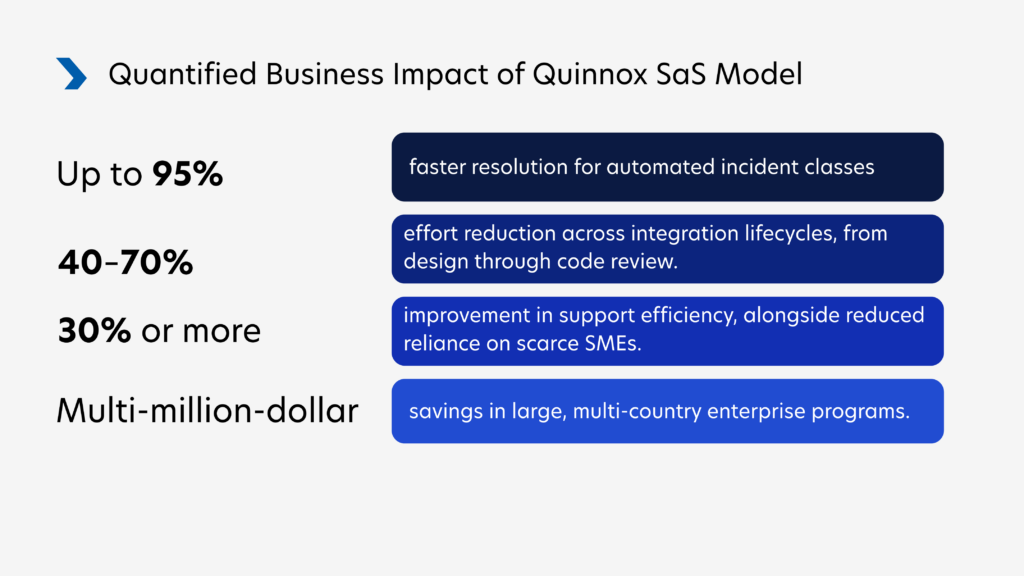
What stands out is that these gains are achieved without forcing enterprises into disruptive, multi-year transformation journeys. The model is designed to coexist with existing environments while progressively rewiring how services are delivered.
Operating-Model Redesign vs. Incremental Automation
Many AMS providers talk about automation. Few truly redesign the operating model.
Incremental automation:
- Improves isolated tasks
- Leaves governance, accountability, and pricing models unchanged
- Delivers localized efficiency but limited systemic impact
A true AMS operating-model redesign:
- Re-architects how work is owned, prioritized, and executed
- Aligns incentives to outcomes, not effort
- Treats automation as a default capability, not an add-on
HFS’s recognition of Quinnox underscores this distinction. Quinnox is not automating yesterday’s AMS; it is building tomorrow’s.
What This Recognition Means for Quinnox Customers
For Quinnox customers, this HFS recognition validates a strategic choice: partnering with a provider that is aligned to where enterprise services are heading, not where they have been.
It means:
- Greater confidence in predictable, outcome-driven service delivery
- Reduced dependency on ever-growing teams to manage complexity
- A practical path to modern AMS without high-risk disruption
Final Thought
As enterprises navigate increasing digital complexity, the future of service delivery will be defined by how intelligently work flows, not by how many resources are assigned to manage it. Services-as-Software represents a shift away from labor-intensive models toward systems that are inherently scalable and resilient.
By rewiring AMS around this operating model, Quinnox is helping enterprises move beyond incremental optimization toward a more sustainable, outcome-focused future.
Are you ready to embrace the future?

Paramita Dey
Assistant Manager, Marketing, Quinnox
Paramita Dey is an Assistant Manager at Quinnox with over a decade of experience in delivering well-articulated pieces on emerging technologies, their business impact, and transformational potential. Beyond her professional pursuits, she is passionate about dancing, traveling and documenting her life through vlogging.
FAQs: Common Questions About Automated Regression Testing
Automated regression tests should ideally run every time a meaningful code change is introduced — especially in CI/CD pipelines. This means:
– On every commit submitted to the main or integration branch
– Before major releases
– After bug fixes, feature updates, or configuration changes
The goal is to catch defects as early and as often as possible to prevent issues from progressing downstream.
Both are essential test types but they serve different purposes:
Smoke Testing: A quick, shallow set of tests to verify core application functionality after a new build. It ensures the system is stable enough for further testing.
Regression Testing: A deeper suite of tests designed to verify that recent changes haven’t broken existing functionality. It’s broader and more comprehensive than smoke testing.
Think of smoke testing as a preliminary check and regression testing as a detailed verification.
In agile environments, yes — especially if the sprint introduces new features, changes, or bug fixes. Regression testing helps maintain quality as the product evolves. Automated regression tests are particularly helpful here because they can be executed quickly and reliably during sprint cycles.
Absolutely! AI and machine learning are transforming automated regression testing:
Self-healing test scripts that adapt to minor UI changes
Predictive analysis to identify high-risk areas for regression
Smart test prioritisation based on usage patterns and history
Automated test generation to expand coverage
Platforms that integrate AI capabilities including those like Qyrus help teams achieve more resilient, efficient, and intelligent regression suites.