
The “honeymoon phase” of Enterprise AI is officially over. For the past eighteen months, boardrooms have been captivated by the magic of Large Language Models (LLMs) and the promise of overnight transformation. We’ve seen a thousand flowers bloom in the form of “Proof of Concepts” (PoCs) and experimental sandboxes.
But as the glitter settles, a sobering reality is setting in: the infrastructure that supported your successful pilot is likely to buckle under the weight of production reality. The next wave of enterprise AI will be defined less by which model you choose and more by how you architect governed infrastructure around it.
Moving AI from a boutique experiment to a core utility like electricity or high-speed internet requires more than just a subscription to an API or a few high-end GPUs in a rack. It requires a fundamental architectural shift. To achieve true scale, security, and ROI, enterprises need a blueprint that treats AI not as a siloed application, but as a living, breathing, and strictly governed ecosystem.
In this guide, we will deconstruct the layers of a production-grade Enterprise AI Infrastructure architecture, moving beyond the hype to build a scalable reference model that stands the test of time.
Why Enterprises Need a Different AI Infrastructure Architecture
In the early days of any technology cycle, we tend to use “borrowed” infrastructure. And hence the practice of running AI on general-purpose cloud instances or repurposed data analytics servers is not something new. However, AI workloads particularly those involving Generative AI and deep learning possess a unique DNA.
Traditional IT infrastructure is built for deterministic outcomes: you input data, the code executes a logic gate, and you get a predictable output. AI is probabilistic. It requires massive, non-linear computational bursts and a level of data throughput that can choke standard enterprise networks.
As Krishna Kumar Chakkirala, Vice President, AI & Data points out regarding this fundamental shift: “Traditional systems were built to execute rules, but modern AI is built to learn from patterns. You cannot run a probabilistic future on a deterministic past. Enterprises need an architecture that doesn’t just store data, but actively fuels the massive parallel processing required to turn that data into live intelligence.”
The Shift from Logic-Based to Data-Centric Computing
In a standard enterprise app, the “code” is the heavy lifter. In AI, the “model” is a mathematical artifact that must be constantly fed, cooled, and monitored. This necessitates a move toward accelerated computing. Furthermore, the “cost of failure” in a production environment is infinitely higher than in a lab.
To solve for the “Three Horsemen” of AI failure namely Latency, Cost, and Compliance, enterprises must adopt a Governed-by-Design approach where governance is not treated as a post-production check rather as a design driver.
1.Governed-by-Design Enterprise AI Architecture
A true production enterprise AI architecture treats governance as the “nervous system” of the stack:
- The Prompt Firewall: Real-time interception of PII and sensitive IP before it leaves your network.
- Data Pedigree: Strict versioning of RAG data to ensure compliance with global privacy laws (like GDPR’s “Right to be Forgotten”).
- Centralized Policy Engines: A single control plane to enforce ethical and security standards across all models, whether they are open-source or proprietary.
To understand the foundational requirements of this shift, exploring a comprehensive AI infrastructure guide can provide the necessary context on how these systems differ from legacy environments.
2.Operating Model for Enterprise AI Infrastructure
Scaling infrastructure requires more than just hardware; it requires a new way of working. Transitioning from “Shadow AI” to an enterprise utility requires a structured operating model:
| Component | Tactical Shift |
|---|---|
| Talent Strategy | Moving from "AI Enthusiasts" to dedicated LLMOps Engineers and AI Policy Officers. |
| Provisioning | Centralized Model-as-a-Service (MaaS) catalogs to prevent API sprawl and shadow billing. |
| Financial Ops | Implementing Token-based Chargebacks to tie AI costs directly to business unit ROI. |
| Feedback Loops | Human-in-the-loop (HITL) workflows that turn user corrections into high-quality fine-tuning datasets. |
From AI Experiments to Production: Infrastructure Gaps Faced by Enterprises
The bridge between a successful pilot and a production-ready system is often broken by several critical “gaps” that only become visible at scale.
- The Data Gravity Gap: In a lab, you use a static “Golden Dataset”—cleaned, curated, and perfect. In production, data is messy, streaming, and heavily siloed. Most enterprises find that their existing data pipelines weren’t built for the low-latency requirements of Retrieval-Augmented Generation (RAG) or real-time model fine-tuning. “Data Gravity” refers to the phenomenon whereas data grows, it becomes harder to move, pulling applications and compute toward it. If your enterprise AI architecture is in the cloud but your data is in a legacy on-prem mainframe, the latency will kill your user experience.
- The Compute Paradox: Scalability is often throttled by the sheer scarcity and cost of high-end compute (GPUs). Without a structured architecture, enterprises often fall into the “Compute Paradox”: they over-provision during periods of low usage (wasting money) or under-provision during peaks (causing system crashes). Production AI requires dynamic orchestration that helps spin up and spin down specialized hardware resources as fluidly as one would handle web traffic.
- The Governance Chasm: Experimental AI often bypasses rigorous security protocols. Production AI cannot. The gap here lies in “Shadow AI”—where departments deploy models without centralized oversight. This leads to massive data leakage risks, where sensitive company IP might be used to train public models inadvertently.
- The Operational (MLOps) Void: Many organizations lack the “plumbing” to monitor model decay. Unlike software, AI models degrade over time as the real-world changes (a phenomenon known as model drift). Without a production architecture, there is no automated feedback loop to retrain and redeploy models, leading to “stale” intelligence.
Bridging these gaps is the first step towards maturity. Before committing to a specific stack, it is vital to learn how to choose the right AI infrastructure tailored to your specific business vertical and data volume.
Enterprise AI Infrastructure Architecture – Reference Model
A scalable reference model for Enterprise AI isn’t just about hardware; it’s a multi-layered stack that ensures data flows seamlessly from storage to inference. Think of it as a five-story building where each floor must be structurally sound for the one above it to function.
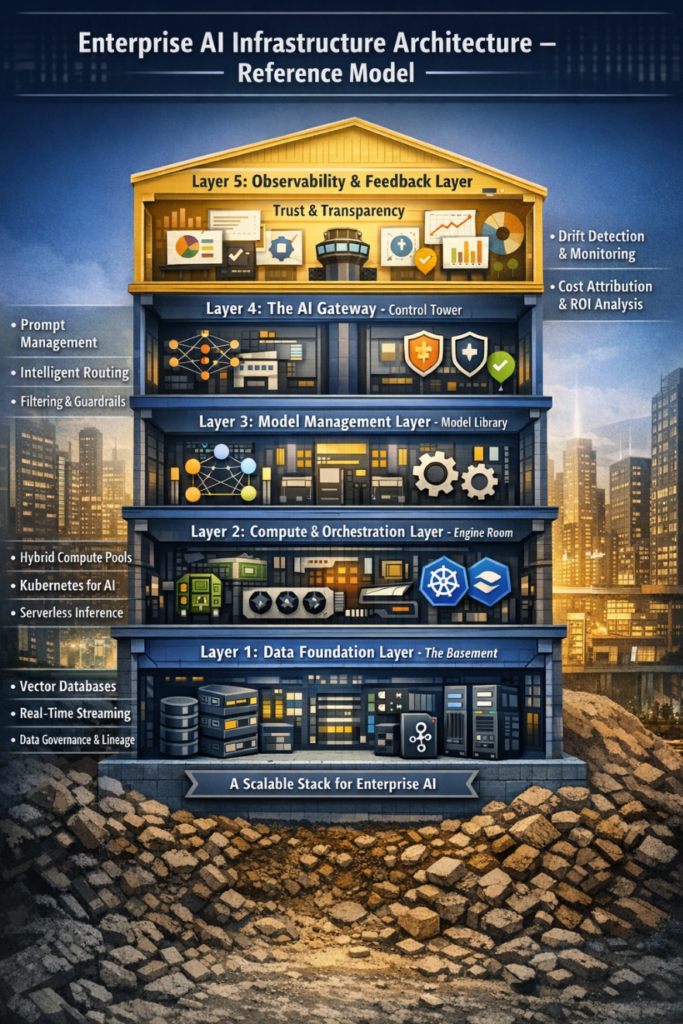
1. Layer 1:The Data Foundation Layer (The Basement)
This is the bedrock. In a production environment, you need more than just a database; you need a Data Fabric.
- Vector Databases: Essential for GenAI, these store data as mathematical “embeddings” to allow for semantic search. When a user asks a question, the system finds the meaning of the query, not just the keywords.
- Real-time Streaming: Tools like Kafka or Flink to handle data as it happens, ensuring the AI isn’t making decisions based on yesterday’s news.
- Data Governance & Lineage: Knowing where data came from and who has access to it. This is non-negotiable for industries like Finance or Healthcare.
2. Layer 2:The Compute & Orchestration Layer (The Engine Room)
This layer abstracts the physical hardware from the data scientists
- Hybrid Compute Pools: A mix of GPUs (for training/fine-tuning) and specialized, low-power ASICs for inference.
- Kubernetes for AI: Containerization allows you to package an AI model and its entire environment, ensuring it runs the same way on a developer’s laptop as it does on a massive server cluster.
- Serverless Inference: For many applications, you don’t need a server running 24/7. Serverless options allow the infrastructure to “wake up” only when a request is made.
3. Layer 3:The Model Management Layer (The Library)
Enterprises should never rely on a single model. This is the “Model Garden” approach.
- Model Registry: A centralized catalog of approved models (Open Source like Llama 3, Proprietary like GPT-4o, or custom-trained models).
- Fine-tuning Pipelines: The automated “gym” where models are periodically updated with new company data.
- Quantization Tools: Techniques that shrink large models so they run faster and cheaper without losing accuracy.
4. Layer 4:The AI Gateway (The Control Tower)
This is where the business logic meets the model.
- Prompt Management: Centralizing the “instructions” given to AI so they can be versioned and tested.
- Intelligent Routing: A traffic controller that decides if a query is simple (send to a cheap, small model) or complex (send to an expensive, large model).
- Filtering & Guardrails: Real-time monitoring to ensure the model doesn’t output toxic content or leak PII (Personally Identifiable Information).
5. Layer 5:The Observability & Feedback Layer
The final layer focuses on “Trust and Transparency.”
- Drift Detection: Alerting engineers when a model’s accuracy starts to dip.
- Cost Attribution: Tracking which department is spending what on “tokens,” allowing for clear ROI calculations.
Deployment Patterns for Enterprise AI Infrastructure
One size does not fit all. Depending on your data sensitivity and budget, you will likely adopt one of these four patterns:
| Pattern | Best For | Pros | Cons |
|---|---|---|---|
| Public Cloud Native | Speed & Innovation | Fast setup; latest hardware; elastic scaling. | Data egress costs; vendor lock-in; privacy concerns. |
| Hybrid AI Cloud | Balanced Compliance | High-security data stays on-prem; heavy training in the cloud. | Architectural complexity; requires "data synchronization." |
| Private AI Cloud | Extreme Security (Gov/Defense) | Total control over data and models; air-gapped security. | High CapEx; difficult to hire talent to manage. |
| Edge AI | Real-time / Low Bandwidth | Millisecond latency; works without internet (e.g., factory floors). | Limited compute power; difficult to update at scale. |
How the Architecture Supports Generative AI at Scale
Generative AI (GenAI) introduces a specific challenge: the Token Economy. Unlike traditional software where the cost of one more user is negligible, every word generated by an LLM has a marginal cost in terms of compute.
Scaling via RAG (Retrieval-Augmented Generation)
A scalable architecture supports GenAI by moving away from “training everything.” Instead of retraining a model every time a company policy changes, the architecture uses the Data Foundation Layer to “look up” the latest policy and provide it as context to the model. This is significantly cheaper and more accurate than fine-tuning.
Intelligent Model Routing
In a production environment, not every task requires a “Frontier Model.” If a customer asks, “What time does your store close?”, using a trillion-parameter model is like using a sledgehammer to crack a nut. A robust architecture includes a routing layer that directs simple tasks to small models (like Mistral 7B) and reserves the “heavy hitters” for complex reasoning. This can reduce operational costs by up to 80% without impacting quality.
Multi-Agent Orchestration
As enterprises mature, they move from a single chatbot to “Agentic Workflows.” One agent might find data, another might analyse it, and a third might write the report. The infrastructure must support these long-running, stateful conversations, which require sophisticated memory management in the Data Layer.
How to Get Started with Enterprise AI Infrastructure Architecture
To move from an “experimental” mindset to a “production-first” stance, your 100-day roadmap needs to focus on de-risking and unit economics. Most organizations fail because they treat AI as a software update; SMEs treat it as a new utility grid.
Here is the differentiated, high-detail breakdown of your 100-day execution plan.
Phase 1: Visibility & Audit (Days 1-30)
Objective: Stop the bleeding of “Shadow AI” and map the terrain
- The Shadow AI Audit: Use network traffic analysis to identify every department hitting OpenAI, Anthropic, or HuggingFace APIs. You cannot govern what you cannot see.
- Deploy the AI Proxy Layer: This is your most critical move. By forcing all AI traffic through a single internal endpoint (an AI Gateway), you gain instant auditability.
- Action: Implement PII stripping at the gateway level. If a developer accidentally pastes customer data into a prompt, the proxy redacts it before it ever leaves your network.
- Data Gravity Mapping: Identify where your “high-value” data lives (ERPs, CRMs, Document Stores). AI shouldn’t move the data; the architecture should bring compute to the data to avoid massive egress costs and latency.
Phase 2: Structural Hardening & MVG (Days 31-60):
Objective: Transition from “it works” to “it’s safe.”
- Standardizing the “Memory” (Vector DB): Many PoCs use local, unmanaged vector stores. You must migrate to an enterprise-grade Vector Database (e.g., Pinecone, Milvus, or Weaviate) that supports Role-Based Access Control (RBAC).
- The Differentiation: Ensure your RAG (Retrieval-Augmented Generation) system respects existing file permissions. If an employee isn’t allowed to see “Salary_2025.pdf” in SharePoint, the AI should not be able to “retrieve” it to answer their question.
- Establishing Minimum Viable Governance (MVG): Deploy automated Red-Teaming agents. These are “adversarial” LLMs designed to try and trick your production models into breaking rules or leaking data, providing a continuous safety score.
Phase 3: The Factory Integration (Days 61–90)
Objective: Build the “Plumbing” for scale.
- The LLMOps Pipeline: Move away from manual model swapping. Implement automated monitoring for Model Drift.
- Action: Set up “Golden Dataset” evaluations. Every time you update your data or model version, automatically run 1,000 test queries to ensure the new version isn’t “hallucinating” more than the last one.
- Token-Based Chargebacks: This is where AI meets the CFO.
- The Differentiation: Tag every API call with a Department_ID. At the end of the month, generate a report showing that “Marketing” spent $4,000 on tokens while “Customer Support” spent $12,000. This forces business units to own their AI ROI.
Phase 4: Optimization & The “Model Shop” (Day 91+)
Objective: Commoditize the models to drive down costs.
- Launch the Internal “Model Shop”: Create a self-service portal for developers. Instead of them managing their own API keys, they “subscribe” to a pre-governed model endpoint (e.g., company-gpt-4o-secure).
- Activate Intelligent Routing: This is the ultimate cost-saver.
- The Differentiation: Implement a “Router” that analyses the complexity of an incoming prompt.
- Simple Task: “Summarize this email” – routed to a cheap, small model (e.g., Llama 3 8B).
- Complex Task: “Analyze this legal contract for risk” – routed to a frontier model (e.g., GPT-4o).
- Result: This typically reduces token spend by 60% to 80% without a perceptible drop in quality.
Conclusion
The infrastructure you build today is the competitive advantage of tomorrow. By focusing on a scalable, modular, and secure architecture, you aren’t just running a pilot—you’re building the engine for the next decade of business growth. Quinnox AI (QAI) Studio enables enterprises to translate this vision into reality by designing and implementing AI infrastructure architectures that are resilient, performance-driven, and future-ready.
From strategic assessment and workload alignment to optimized deployment and governance, QAI Studio ensures your AI foundation is built to scale with confidence. With its ready-to-use, scalable environments, QAI Studio provides pre-configured storage and computing resources, ensuring seamless data processing, model training, and inferencing.
With the right architecture in place, organizations can accelerate innovation, reduce operational risk, and create sustained competitive advantage in an AI-first world.
FAQs
It is the holistic framework of hardware (GPUs, storage), software (orchestrators, MLOps), and data pipelines (Vector DBs) designed specifically to support the development and production deployment of AI models. It focuses on scalability, security, and cost-efficiency.
The core components include accelerated compute (GPUs), a data fabric for unified data access, a model registry for versioning, MLOps for lifecycle management, and an AI gateway for security and routing.
It enables technologies like RAG to keep models updated without expensive retraining, provides guardrails to prevent hallucinations, and manages “Token” costs through intelligent routing between large and small models.
Absolutely. In fact, many highly regulated industries prefer a hybrid approach where sensitive data is processed on-prem using local LLMs, while less sensitive, high-compute training tasks are burst to the public cloud.
The “Big Five” are:
-The Data Layer (Vector & Graph DBs)
-The Compute Layer (GPU Orchestration)
-The MLOps Layer (Lifecycle & Monitoring)
-The Gateway Layer (Security & Prompts)
-The Governance Layer (Compliance & Cost)