Introduction
Data rarely becomes a business problem because an organization does not have enough of it. It becomes a problem when no one can confidently answer what the data means, whether it can be trusted, or who is responsible for fixing it when it goes wrong.
In other words, data itself isn’t the problem but trust in that data is. Supporting this, PwC’s 2025 Global Compliance Survey reports that 56% of business leaders identify unreliable data as one of the biggest barriers to staying compliant.
This is where data stewardship becomes important.
A data steward sits close to the business context of data, helping translate definitions and expectations into day-to-day practices that keep data understandable, usable, and fit for purpose. But effective stewardship is not created by simply assigning someone a title. Without clear responsibilities, decision rights, organizational backing, and measurable outcomes, the role can quickly become another item on an already crowded job description.
That is why the real challenge is not whether an organization needs data stewards. It is how to design the data steward role so that it has the authority, operating model, and accountability to make a measurable difference.
This blog examines what data stewardship actually involves, how the data steward differs from the data owner, how stewardship models work across domains, and why seemingly well-designed stewardship programmes often fail. It also explores how the role is changing as AI systems increasingly consume and act on enterprise data.
What is data stewardship?
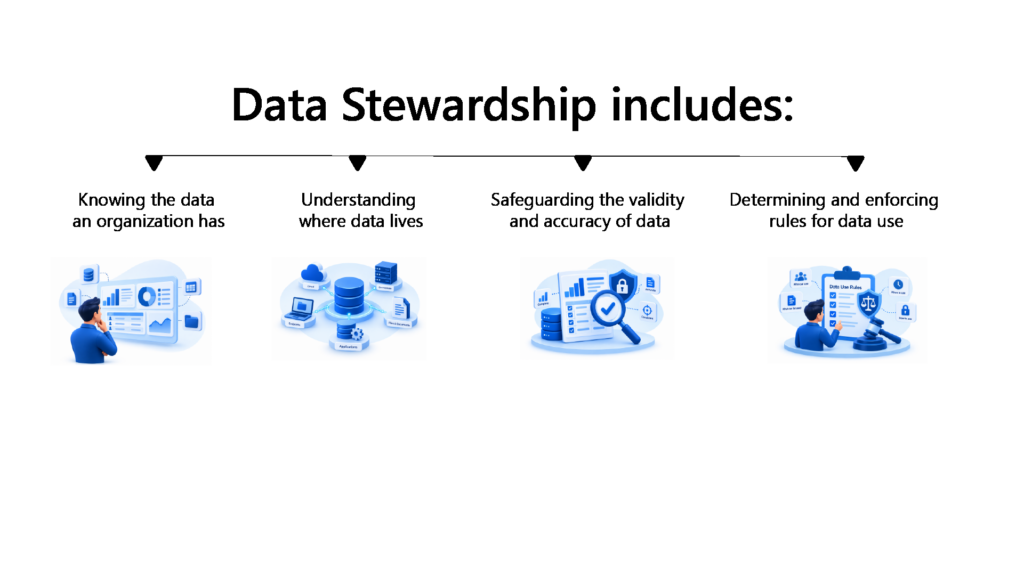
Data stewardship is the ongoing business and operational practice of ensuring that data is understood, usable, appropriately managed, and fit for its intended business purpose. It connects organizational expectations about data with the people and processes that work with that data every day.
The term can refer to both a function and a role.
As a function, data stewardship is the set of activities through which an organization maintains business definitions, resolves data issues, coordinates data-quality improvements, and helps ensure that data is used consistently within a defined scope.
As a role, a data steward is the person accountable for carrying out or coordinating those activities for a particular data domain, subject area, process, or set of data assets.
The distinction is important. Stewardship is bigger than an individual’s job description. A person may perform stewardship activities, but those activities need to fit into an operating model that connects business domains, technical teams, data leadership, and decision-making forums.
A steward is therefore not simply the person who “checks data quality.” The role exists at the intersection of business meaning, operational reality, and data management.
What does a data steward do?
A data steward translates expectations about data into practical action within the area they support. The exact responsibilities vary by organization and domain, but the role generally revolves around one question:
Can the people and systems using this data understand it, trust it, and use it consistently for its intended purpose?
That question gives the role considerably more depth than maintaining a glossary or responding to data-quality tickets.
Day-to-day Responsibilities
The day-to-day responsibilities of a data steward can include:
- Defining and clarifying business meaning: Establishing what important data elements, terms, measures, and attributes mean in the context of the business.
- Maintaining business definitions: Keeping definitions current as products, processes, policies, and reporting requirements change.
- Identifying data-quality issues: Monitoring recurring problems such as missing, duplicate, inconsistent, invalid, or outdated information.
- Coordinating issue resolution: Working with business and technology teams to determine the cause of a data problem and coordinate corrective action.
- Establishing data-quality expectations: Helping define what “good enough” means for critical data in a particular business context.
- Supporting consistent usage: Helping teams apply agreed definitions and business rules consistently across processes and analytical use cases.
- Supporting data consumers: Answering questions about what data means, where it should be used, and whether it is appropriate for a particular business purpose.
- Escalating unresolved issues: Bringing conflicts or persistent quality problems to the appropriate owner or decision-making forum.
- Maintaining stewardship records: Keeping relevant definitions, issue decisions, rules, and responsibilities current.
- Collaborating with technology teams: Translating business expectations into requirements that data engineers, application teams, analysts, and other technical stakeholders can act on.
- Collaborating with technology teams: Translating business expectations into requirements that data engineers, application teams, analysts, and other technical stakeholders can act on.
The strongest stewards do not merely document problems. They help the organization close the loop between identifying a data issue and changing the process, system, rule, or behavior that caused it.
Consider a customer domain where a customer segment is defined differently by marketing, sales, and finance. A weak stewardship approach might document the three definitions. A stronger data steward would identify the business conflict, determine which use cases require which interpretation, coordinate agreement among stakeholders, and help ensure that the agreed definitions are reflected in downstream usage.
This is why the data steward role requires both domain knowledge and the ability to influence people outside the steward’s direct reporting line.
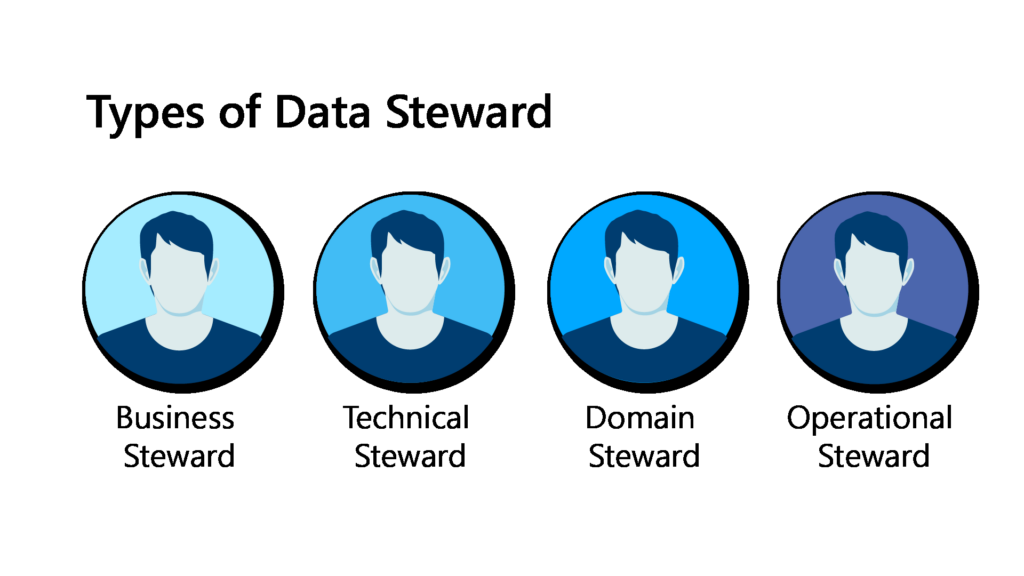
Business Steward vs Technical Steward
The data steward role can take different forms depending on where responsibility sits within the organization. While business and technical stewards share the same objective – making data reliable, usable, and fit for purpose – their focus and day-to-day responsibilities differ. Understanding this distinction helps organizations assign the right responsibilities without creating gaps or duplication.
A business data steward focuses primarily on the meaning, business use, quality expectations, and operational context of data. They are typically close to a business domain and understand how data is created and consumed in real processes.
A technical data steward focuses more heavily on how those expectations are implemented within data and technology environments. They may work with data engineers, application teams, architects, analysts, or platform teams to translate business requirements into technical controls and corrective actions.
The two roles should not become isolated silos.
For example, a business steward may determine that “active customer” needs a specific business definition. A technical steward may help translate that definition into data rules, transformations, validation mechanisms, or implementation requirements. One establishes and interprets the business expectation; the other helps operationalize it.
In smaller organizations, the same person may perform both forms of stewardship. In larger enterprises, responsibilities may be distributed across domain stewards, technical stewards, and supporting data teams.
The critical factor is not the title. It is whether someone has clear responsibility for making data usable and understandable within a defined scope and the organizational access required to act on problems.
Data Steward vs Data Owner
The distinction between data steward vs data owner is one of the most important clarifications in any stewardship model.
A data owner generally has formal accountability for a data domain or asset and the authority to make decisions about its use, priorities, quality expectations, and management. The owner is ultimately accountable for decisions.
A data steward, by contrast, is typically responsible for the ongoing operational coordination that makes those decisions work in practice.
The two roles therefore complement each other rather than compete. A steward may identify a recurring quality issue and recommend a corrective action, while the owner has the authority to prioritize that action, resolve competing business requirements, or accept a particular level of risk.
| Data Steward | Data Owner |
|---|---|
| Coordinates day-to-day stewardship activities | Holds formal accountability for the data domain |
| Clarifies and maintains business definitions | Approves or establishes key expectations |
| Identifies and coordinates resolution of data issues | Makes or authorizes higher-level decisions |
| Works closely with data producers and consumers | Sets priorities and provides direction |
| Monitors data-quality concerns within scope | Accountable for the overall state of the domain |
| Usually influences without direct authority | Typically has greater decision-making authority |
A common failure occurs when organizations give a steward responsibilities that effectively belong to an owner without giving the steward equivalent authority. The steward then becomes responsible for problems they cannot resolve.
Effective data stewardship requires the two roles to be explicitly connected.
The Stewardship Operating Model
A stewardship operating model defines where stewards sit, whom they work with, how decisions move, and how issues are escalated.
In a domain-oriented enterprise, stewards usually operate close to the business domains that create and consume data. They interact with domain leaders and data owners while coordinating with technical teams that implement changes. A central data leadership function, such as the CDO organization, provides enterprise direction, standards, coordination, and enablement rather than attempting to perform every stewardship activity itself.
Councils or cross-domain forums can provide a place for stewards and owners to resolve issues that span multiple domains. The precise structure varies by organization, but the principle remains consistent: stewardship should be close enough to the data to understand its context and connected enough to the enterprise to resolve cross-domain conflicts.
- Federated stewardship
In a federated model, stewardship responsibilities are distributed across business or data domains while a central function provides coordination and common direction.
This model works particularly well for large enterprises where finance, manufacturing, customer, supply chain, product, and other domains have substantially different data needs. Domain stewards can make decisions in context rather than relying on a central team that may not understand operational nuances. The trade-off is consistency: without effective coordination, each domain can develop its own interpretation of stewardship.
- Centralised stewardship
In a centralised model, a dedicated team performs most stewardship activities from a central organizational structure.
This can provide greater consistency and make stewardship easier to coordinate when the organization has a relatively concentrated data landscape or limited domain complexity. However, central teams can struggle to understand local business processes and may become a bottleneck for issue resolution. Centralisation can therefore create distance between the people responsible for stewardship and the people who actually create and use the data.
In practice, many enterprises use a hybrid model: central leadership and enablement combined with domain-level stewardship.
Data Stewardship Best Practices
The most effective data stewardship best practices are practical rather than purely procedural:
1.Assign stewards to clearly defined domains so responsibility does not become an enterprise-wide abstraction.
2.Write down the steward’s decision rights and escalation paths instead of relying on informal influence.
3.Prioritize critical data elements and high-impact use cases rather than attempting to steward every field equally.
4.Measure data-quality outcomes such as issue recurrence, resolution time, completeness, validity, or business-impact reduction.
5.Connect stewards with data owners and technical teams so identified issues can move from discussion to remediation.
6.Protect stewardship capacity by making it a recognized responsibility rather than an unplanned administrative task.
7.Review stewardship responsibilities as the business changes because domains, processes, applications, and data uses evolve.
These practices also sit within the broader discipline of data governance services, while strategic data management provides the broader business context for deciding where stewardship effort creates the most value.
Why stewardship programmes fail
Many stewardship programmes do not fail because the organization misunderstands the value of trustworthy data. They fail because the role is designed without sufficient organizational support.
As Kumar Vineet, Senior Manager-AI & Data, Everforth Quinnox, explains:
“Many stewardship initiatives struggle because organizations assign responsibility without creating the conditions to act. A steward can identify a data-quality issue, but unless decision rights, escalation paths, and business ownership are clear, the issue can remain unresolved.”
1. Stewardship assigned as a side-of-desk duty
The most common problem is treating stewardship as something employees can perform “when they have time.”
A subject-matter expert may be named a steward because they understand the domain. But if their primary performance objectives, workload, and incentives remain unchanged, stewardship becomes secondary.
The result is predictable: definitions are not updated, issues remain unresolved, meetings are missed, and stewardship activity becomes reactive.
The problem is not necessarily the individual. The role was never given capacity to succeed.
2. Accountability without authority
A steward may be expected to resolve conflicting definitions, improve data quality, coordinate multiple teams, and enforce agreed practices but have no authority over the systems, processes, budgets, or teams causing the problem.
This creates accountability without control.
A useful stewardship model therefore distinguishes between responsibility, accountability, authority, and escalation. Stewards need not own every decision, but they must know who does and have a reliable mechanism for getting decisions made.
3. No measurable outcome attached to the role
If success is measured by the number of glossary entries created or stewardship meetings attended, the organization can appear active without actually improving its data.
Better measures connect stewardship to outcomes.
For example, a steward supporting customer data might be measured against reductions in recurring data-quality issues, faster resolution of critical defects, improved completeness of priority attributes, or fewer business disputes caused by inconsistent definitions.
The measurement should reflect the business consequence of better stewardship, not simply the volume of stewardship activity.
Stewardship in an AI context
AI changes the importance of stewardship because data is no longer consumed only by people running reports or applications following predefined workflows. AI agents can retrieve, interpret, combine, summarize, and act on enterprise data at machine speed. That makes ambiguity in business meaning more consequential. A poorly defined field that causes occasional confusion for an analyst can become a repeatable source of incorrect recommendations or actions when consumed by an AI system at scale.
This makes the data steward’s role increasingly focused on context and usability. Stewards need to help establish whether critical data has a clear business meaning, whether important attributes are sufficiently reliable for their intended use, and whether conflicting interpretations are visible rather than silently propagated. Their work becomes part of the foundation for governing data for AI, without turning stewardship itself into a substitute for the broader controls required around AI systems.
Conclusion
Data stewardship is ultimately less about maintaining documentation and more about creating sustained accountability for the meaning, quality, and usability of data within the business.
The data steward role works when it is anchored in a clear domain, connected to data owners, supported by technical teams, and measured against meaningful outcomes. It fails when organizations assign responsibility without capacity, authority, or a path to resolution.
Effective data stewardship starts with a clear understanding of who is responsible for the data, where that responsibility sits within each domain, and how stewards work with data owners and technical teams. It then goes further by connecting stewardship to measurable business outcomes leading to fewer recurring data issues, faster resolution, more consistent use of critical data, and greater confidence in the decisions that depend on it.
Organizations that consider data stewardship from a compliance exercise to a business capability are the ones who make their data more reliable, usable, and ready for what comes next.

Deputy Manager, Marketing, Everforth Quinnox
Frequently Asked Questions
Data stewardship is the ongoing practice of ensuring that data is clearly understood, consistently defined, fit for its intended business use, and supported by appropriate quality and accountability. A data steward works within a specific business or data domain to clarify definitions, identify and coordinate the resolution of data-quality issues, support consistent data usage, and connect business requirements with technical teams.
A data owner has formal accountability and decision-making authority for a data domain, while a data steward manages and coordinates the day-to-day activities required to keep that data usable, consistent, and fit for purpose. The owner typically sets priorities and makes key decisions; the steward helps implement those expectations, resolves or escalates issues, maintains definitions, and works with business and technical stakeholders.
A data steward should be someone with strong knowledge of the business domain and how its data is created, used, and interpreted. This is often a subject-matter expert, business analyst, process owner, or data professional who can work effectively across business and technology teams. Technical skills alone are not enough. A good steward needs business context, attention to data quality, communication and influencing skills, and enough organizational standing to coordinate issue resolution and escalate decisions when necessary.
There is no fixed number of data stewards an organization needs. The appropriate number depends on the number and complexity of data domains, the volume of critical data, organizational structure, regulatory requirements, and how widely data is shared across business functions. Rather than assigning one steward to every system or dataset, organizations should typically assign stewardship at the domain or subject-area level, prioritizing areas where poor data quality or inconsistent definitions have the greatest business impact.