Introduction
Data has become one of the most valuable assets an organization possesses. It informs business strategies, shapes customer experiences, supports regulatory compliance, and increasingly powers artificial intelligence (AI). But having access to large volumes of data does not automatically translate into better decisions. The real value lies in knowing whether the data can be trusted, who is accountable for it, and how it should be managed.
Consider a financial services company preparing to launch a new credit risk model. Its customer database contains duplicate records, inconsistent income figures, and outdated addresses. At the same time, different departments follow different rules for accessing and updating customer information. The company faces two connected problems: its data is unreliable, and there is no consistent framework for managing it.
This is where data governance and data quality come into play.
Although the terms are often used interchangeably, they address different aspects of data management. Data governance establishes the policies, responsibilities, and controls that guide how data is managed. Data quality focuses on whether the data is accurate, complete, consistent, timely, and fit for its intended purpose.
Understanding data governance vs data quality is important but recognizing how the two work together is even more valuable. Organizations need both to make confident decisions, reduce operational risks, and build a reliable foundation for AI-driven innovation.
What Is Data Governance?
Data governance is the framework of policies, standards, roles, and processes that determines how an organization manages, protects, accesses, and uses its data throughout its lifecycle.
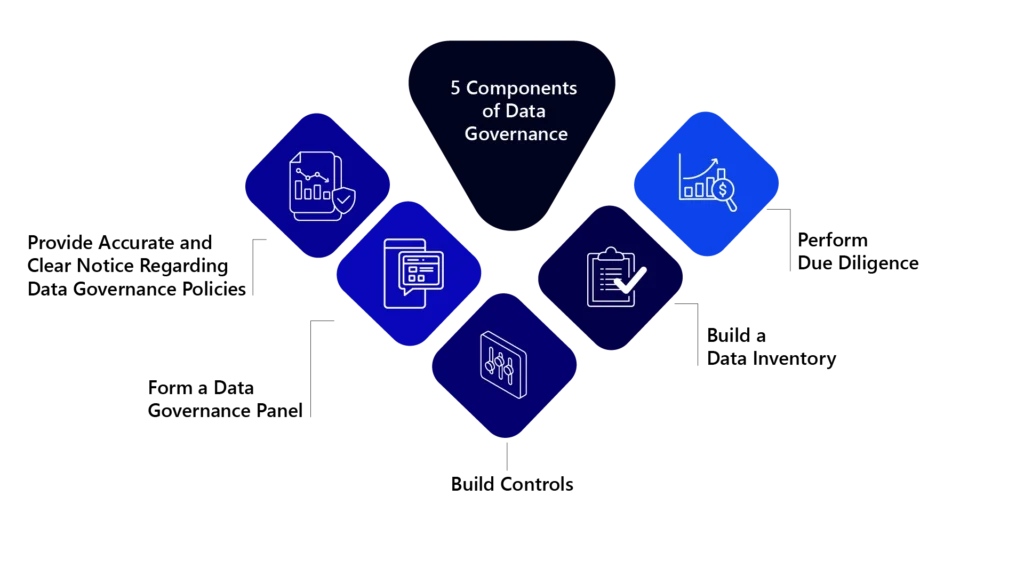
Think of data governance as the set of rules that keeps an organization’s data practices consistent and accountable. It answers fundamental questions: Who owns a particular dataset? Who can access it? Which definitions should teams follow? What regulations apply? Who is responsible when something goes wrong?
A well-defined data governance framework typically includes:
- Data ownership and stewardship: Establishing accountability for data assets and assigning people to oversee their appropriate use and management.
- Policies and standards: Defining consistent rules for data collection, classification, storage, sharing, retention, and disposal.
- Access and security controls: Determining who can view, modify, or share data based on business needs and permissions.
- Regulatory compliance: Ensuring data practices align with applicable privacy laws, industry regulations, and internal policies.
- Metadata and lineage management: Documenting what data means, where it originates, how it changes, and where it is used.
- Decision-making and accountability: Creating processes for resolving data-related issues and managing exceptions.
For example, a retail organization may establish a governance policy that defines a customer, specifies which system serves as the authoritative source for customer information, and determines which teams can access sensitive personal details.
These policies establish the conditions under which customer data should be managed. They do not, by themselves, guarantee that every customer record is accurate. That requires data quality practices.
This is where enterprise data governance helps create the structure within which data can be managed consistently, securely, and responsibly across the organization.
What Is Data Quality?
Data quality refers to the degree to which data meets the requirements of its intended use. High-quality data is reliable enough to support the decisions, processes, and applications that depend on it.
The key consideration is that data quality is contextual. A dataset that is adequate for generating a high-level market trend report may not be sufficiently accurate for processing financial transactions or assessing individual credit risk.
Data quality is commonly evaluated across several dimensions:
- Accuracy: Does the data correctly represent the real-world information it is intended to capture?
- Completeness: Are all the necessary fields and records present?
- Consistency: Is the same information represented consistently across systems?
- Timeliness: Is the data current enough for the intended business purpose?
- Validity: Does the data conform to defined formats, rules, and acceptable values?
- Uniqueness: Are duplicate records identified and appropriately managed?
Imagine an e-commerce company whose inventory system shows that 100 units of a product are available, while its warehouse management system reports only 65. The discrepancy could lead to overselling, delayed deliveries, and frustrated customers.
Data quality processes help identify and address such inconsistencies. These processes may include data profiling, validation, cleansing, deduplication, reconciliation, and continuous monitoring.
However, data quality is not simply about correcting errors after they occur. It also involves identifying the sources of those errors and preventing them from recurring.
That distinction brings data quality closer to data governance: governance establishes the standards and accountability, while data quality practices help ensure that the data meets those standards.
Data Governance vs. Data Quality: Key Differences
Data governance and data quality are closely related, but they serve different purposes. One establishes how data should be managed; the other evaluates whether that data is reliable enough to use.
| Aspect | Data Governance | Data Quality |
|---|---|---|
| Primary objective | Establish accountability, policies, and control over data | Ensure data is accurate, complete, consistent, and fit for use |
| Scope | Organization-wide data management and oversight | The condition and usability of specific datasets |
| Key question | Who manages the data, under what rules, and with what accountability? | Can the data be trusted for its intended purpose? |
| Primary stakeholders | Data governance councils, data owners, stewards, compliance, IT, and business leaders | Data stewards, data engineers, analysts, business users, and quality teams |
| Typical activities | Policy development, ownership assignment, access management, classification, and lineage oversight | Profiling, validation, cleansing, deduplication, reconciliation, and monitoring |
| Common metrics | Ownership coverage, policy compliance, stewardship coverage, and issue resolution | Accuracy, completeness, consistency, validity, timeliness, and duplicate rates |
| Business outcome | Consistent, secure, accountable data management | Reliable data for reporting, operations, analytics, and AI |
The differences become clearer when we look at their objectives, responsibilities, processes, and measurement approaches.
Differences in Objectives and Scope
Data governance takes a broad, organizational view of data. It establishes the principles and rules that apply across departments, systems, and business functions.
Its scope may include data privacy, security, access rights, regulatory compliance, ownership, retention, and appropriate use. The objective is to make data management consistent, accountable, and aligned with business priorities.
Data quality has a more specific operational focus: ensuring that data meets defined standards and serves its intended purpose.
For instance, a bank’s data governance framework may establish a standard definition of an active customer and designate the authoritative system for customer information. Data quality processes then assess whether customer records across the bank’s systems follow that definition and contain the required information.
The distinction is simple: governance defines the expectations; quality measures how well the data meets them.
Differences in Roles and Responsibilities
Data governance distributes accountability across the organization rather than leaving data management entirely to IT.
Typical roles include:
- Data governance council: Establishes priorities, approves policies, and resolves cross-functional data issues.
- Data owners: Take accountability for specific data domains and make decisions about their use and management.
- Data stewards: Help define data standards, monitor compliance, and coordinate the resolution of data issues.
- IT and data engineering teams: Implement technical controls, data pipelines, access mechanisms, and quality checks.
- Business users: Follow established practices and report data problems that affect business operations.
Data quality responsibilities are more directly associated with identifying, measuring, investigating, and resolving data defects.
For example, a finance data owner may define the requirements for accurate revenue reporting. A data steward may investigate discrepancies between finance and sales records, while data engineers implement validation rules to prevent invalid entries from reaching reporting systems.
These responsibilities overlap, but they are not interchangeable. Data governance establishes who is accountable and what standards apply. Data quality activities help those stakeholders identify whether the standards are being met.
Differences in Processes and Activities
Data governance processes are designed to establish and maintain control over data throughout its lifecycle.
These may include defining data policies, maintaining business glossaries, assigning ownership, managing access permissions, documenting lineage, and establishing processes for policy exceptions.
Data quality processes focus on the condition of data and the steps required to improve it. Common activities include:
- Profiling datasets to understand their structure and identify anomalies.
- Validating records against business rules.
- Standardizing inconsistent formats and values.
- Identifying duplicates and resolving conflicting records.
- Reconciling information across systems.
- Monitoring quality trends and investigating recurring defects.
Consider an organization that discovers different departments use different formats for customer addresses.
Data governance can establish a standard address format, identify the responsible data owner, and define the process for managing changes. Data quality processes can then identify noncompliant records, standardize values where appropriate, and monitor whether the problem recurs.
When both processes operate together, organizations can move beyond correcting individual errors to addressing the underlying causes.
Differences in Metrics and Measurement
Because data governance and data quality pursue different objectives, their success should be measured differently.
Governance metrics indicate whether policies, responsibilities, and controls are established and working as intended. Examples include the percentage of critical data assets with assigned owners, policy compliance rates, and the time required to resolve governance issues.
Data quality metrics evaluate the reliability of the data itself. These include completeness rates, validation failure rates, duplicate-record percentages, and the age of data used in business-critical processes.
Neither set of metrics tells the whole story on its own.
A company may have assigned owners for every critical dataset but still struggle with inaccurate records. Conversely, a dataset may achieve high accuracy today without having a clear owner or a process for maintaining that accuracy over time.
Measuring both governance effectiveness and data quality provides a more complete view of the organization’s data management maturity.
How Data Governance and Data Quality Work Together
Data governance and data quality are most effective when they operate as complementary parts of a continuous improvement cycle.
Governance establishes the policies, standards, and accountability needed to manage data. Data quality practices assess whether the data meets those standards. When issues arise, governance helps determine who should address them, while quality processes support investigation, correction, and prevention.
The resulting improvements can then be measured and used to refine policies and controls.
Consider a manufacturer that relies on supplier data to plan production and manage procurement.
Its governance framework defines the required supplier information, identifies the authoritative system for supplier records, and assigns responsibility for maintaining those records. Data quality controls check whether supplier details are complete, tax identifiers are valid, and payment information is consistent across relevant systems.
If a supplier record repeatedly fails validation, the quality monitoring process identifies the problem. The data steward investigates the cause, while the data owner determines whether the existing standards or business processes need to change. Technical teams can then introduce preventive controls.
This creates a feedback loop in which governance guides quality improvements, and quality findings reveal where governance or operational processes need attention.
For organizations pursuing strategic data management, this connection is particularly important. Rather than treating governance and quality as separate initiatives, businesses can align both with shared priorities, measurable outcomes, and the needs of the people using the data.
The goal is not to run two separate initiatives. It is to create one coordinated approach to managing data responsibly and keeping it useful.

“Data governance defines the standards and accountability an organization needs, but its real value is realized when those standards translate into reliable, usable data. Governance and data quality cannot operate in isolation. They must work together to ensure data remains trustworthy as it moves across systems, teams, and business processes.”
Krishna Kumar Chakirala, VP
AI & Data, Everforth Quinnox
Real-World Examples of Data Governance vs. Data Quality
The practical distinction between governance and quality becomes easier to understand when viewed through everyday business scenarios.
1. Banking and Financial Services
A bank needs reliable customer and transaction data to support regulatory reporting, fraud detection, credit decisions, and personalized services.
Data governance in action: The bank defines ownership of customer and transaction data, establishes access policies for sensitive information, and specifies which systems serve as authoritative sources.
Data quality in action: Teams validate customer identifiers, reconcile transaction records, identify duplicates, and monitor missing or inconsistent information.
Why both matter: Governance helps ensure that sensitive data is handled appropriately and that accountability is clear. Quality controls help ensure that decisions and reports are based on dependable information.
2. Retail and E-commerce
A retailer depends on consistent product, inventory, pricing, and customer data to coordinate its online and physical stores.
Data governance in action: The retailer establishes common product definitions, identifies owners for product and inventory data, and defines how information is shared between commerce, warehouse, and finance systems.
Data quality in action: Automated checks identify missing product attributes, inconsistent prices, duplicate listings, and mismatches between recorded and actual inventory.
Why both matter: Governance creates consistency across channels, while quality helps prevent stock discrepancies, incorrect listings, and avoidable customer dissatisfaction.
3. Healthcare
Healthcare organizations need dependable patient, clinical, and administrative data to support care delivery, reporting, and operational decisions.
Data governance in action: Policies define access to sensitive information, clarify data ownership, establish retention requirements, and specify appropriate data-sharing practices.
Data quality in action: Validation checks identify incomplete patient records, inconsistent identifiers, missing clinical fields, and conflicting information across systems.
Why both matter: Governance supports responsible data handling and accountability. Quality helps ensure that clinicians and administrators work with information appropriate to the task at hand.
4. Manufacturing and Supply Chain
Manufacturers rely on product specifications, supplier information, equipment data, and inventory records to maintain operational efficiency.
Data governance in action: The organization defines standards for product and supplier master data, assigns owners, and establishes rules for updating critical information.
Data quality in action: Teams monitor missing specifications, inconsistent units of measurement, duplicate supplier records, and discrepancies between inventory systems.
Why both matter: Governance provides a consistent framework for managing operational data, while quality helps reduce planning errors, procurement delays, and avoidable disruptions.
Across these industries, the pattern remains the same: governance determines how data should be managed, and quality determines whether the information is reliable enough for its intended use.
Key Metrics for Data Governance and Data Quality
Effective measurement helps organizations move from broad commitments to observable improvements. The right metrics should reflect business priorities rather than simply the number of policies written or errors detected.
Data Governance Metrics
Useful governance indicators include:
- Data ownership coverage: Percentage of critical data assets with formally assigned owners.
- Stewardship coverage: Percentage of priority data domains with active stewardship responsibilities.
- Policy compliance rate: Percentage of assessed data assets or processes meeting defined governance requirements.
- Access review completion: Percentage of scheduled access reviews completed within the required period.
- Governance issue resolution time: Time taken to resolve ownership disputes, policy exceptions, or other governance issues.
- Metadata and lineage coverage: Percentage of critical datasets with documented definitions, sources, and lineage.
These indicators help determine whether governance responsibilities and controls are consistently applied.
Data Quality Metrics
Data quality indicators should reflect the dimensions that matter most to a particular use case.
- Completeness rate: Percentage of required fields or records containing the necessary information.
- Accuracy rate: Percentage of assessed records that correctly reflect the underlying facts, based on a reliable verification method.
- Consistency rate: Percentage of records meeting agreed consistency rules across systems.
- Validity rate: Percentage of records conforming to defined formats and business rules.
- Duplicate rate: Percentage of records identified as duplicates under agreed matching criteria.
- Timeliness: Percentage of data updates meeting defined freshness or delivery requirements.
- Defect resolution time: Average time required to investigate and resolve identified quality issues.
Therefore, organizations should establish baselines, define how each metric is calculated, and set targets based on business risk and operational needs.
Common Challenges in Managing Data Governance and Data Quality
Even organizations that recognize the importance of data governance and quality often struggle to implement them consistently. The challenges usually stem from a combination of organizational complexity, fragmented systems, and unclear accountability.
Siloed Data and Conflicting Definitions
Different departments may maintain separate versions of the same information. Marketing, sales, and finance, for instance, may use different criteria to define an active customer or calculate revenue.
Without shared definitions and agreed authoritative sources, reports can produce conflicting results even when each team believes its data is correct.
Unclear Ownership and Accountability
Data quality issues frequently persist because no one is clearly responsible for resolving them.
IT teams may be expected to fix problems that originate in business processes, while business teams may assume that technical teams are accountable for all aspects of data reliability. Governance structures must clarify these responsibilities and provide an escalation path when issues cross departmental boundaries.
Legacy Systems and Fragmented Architectures
Organizations often operate a mix of legacy applications, cloud platforms, data warehouses, and third-party systems. Information may be transformed, duplicated, or lost as it moves between them.
This makes it difficult to establish consistent standards, trace data lineage, and identify the source of an error.
Manual Processes and Reactive Fixes
When data quality monitoring relies on spreadsheets, periodic audits, or user-reported issues, defects can remain undetected until they affect a business process.
Teams may spend considerable time correcting the same problems repeatedly instead of identifying their root causes and preventing recurrence.
Governance Perceived as Bureaucracy
Governance initiatives can struggle when employees see them as additional approvals, documentation, or restrictions that slow down delivery.
If policies are disconnected from everyday workflows, adoption suffers. Governance becomes more effective when it is proportionate to risk, easy to understand, and integrated into the tools and processes employees already use.
Balancing Accessibility, Privacy, and Control
Organizations need data to be accessible enough to support innovation without compromising privacy, security, or regulatory obligations.
Achieving that balance requires clear access rules, appropriate controls, and an understanding of how data is used across its lifecycle.
Addressing these challenges requires more than purchasing a new platform. It calls for clear ownership, shared standards, appropriate technology, and a culture in which data reliability is treated as a collective responsibility.
Best Practices for Improving Data Governance and Data Quality
Building a dependable data environment does not require an organization to transform every dataset at once. Instead, AI compliance best practices require more practical approach that prioritizes critical data, establishes accountability, introduces measurable standards, and improve incrementally.
Assign Clear Data Ownership
Every critical data domain should have a clearly identified owner who is accountable for its appropriate management and use.
Ownership should be supported by defined stewardship responsibilities, documented decision rights, and an escalation process for resolving issues.
Start with high-value domains such as customer, product, supplier, financial, or employee data, depending on the organization’s priorities. Make responsibilities explicit so that issues are directed to the people who can resolve them.
Standardize Definitions and Quality Rules
Inconsistent business definitions are a common source of unreliable reporting.
Create a shared business glossary that defines important terms, identifies authoritative data sources, and documents the rules that apply to critical fields and records.
For example, an organization should establish a common definition of revenue, an active customer, or an approved supplier before automating related reports and controls.
Translate these definitions into measurable quality rules wherever possible. This helps business teams, analysts, and engineers work from the same expectations.
Automate Data Quality Monitoring
Manual checks may be sufficient for small datasets or occasional reviews, but they become difficult to sustain as data volumes and processing speeds increase.
Automated monitoring can identify missing values, invalid formats, duplicates, unexpected changes, and violations of business rules as data moves through pipelines and applications.
Organizations should prioritize alerts based on business impact rather than treating every defect as equally urgent. Monitoring should also capture trends, recurring failures, and the time required to resolve issues.
Automation does not eliminate the need for human judgment. It helps teams detect problems earlier and direct their attention toward the issues that matter most.
Embed Governance into Data Workflows
Governance is more effective when it becomes part of everyday data operations rather than a separate administrative exercise.
Integrate access controls, data classification, validation rules, metadata capture, and lineage documentation into data pipelines, application workflows, and analytics environments.
For example, a new dataset could require an assigned owner, a documented business definition, an appropriate access classification, and agreed quality checks before it becomes available for wider use.
Embedding these requirements into workflows makes compliance more consistent and reduces reliance on manual intervention.
Monitor Outcomes and Continuously Improve
Data governance and quality should evolve as business requirements, regulations, systems, and data usage change.
Establish baseline measurements, track progress against defined targets, and periodically review whether the current controls are delivering the expected results.
When recurring defects appear, investigate their root causes. A persistent completeness issue, for instance, may reflect a poorly designed data-entry process rather than an isolated technical problem.
Use business outcomes to guide improvement. Relevant indicators may include reduced reconciliation effort, fewer reporting discrepancies, faster issue resolution, improved operational performance, and greater confidence in analytics.
Regular reviews should bring data owners, stewards, technical teams, and business stakeholders together to prioritize improvements and refine standards.
The guiding principle is to treat data governance and data quality as ongoing capabilities, not one-time implementation projects.
The Role of Data Governance and Quality in AI Readiness
As organizations move from traditional analytics to generative AI and autonomous AI agents, the importance of trustworthy data becomes even more pronounced.
AI systems depend on data to retrieve information, recognize patterns, generate responses, and support decisions. When that data is outdated, inconsistent, incomplete, or poorly understood, the resulting outputs may be misleading or unreliable.
Even sophisticated AI models cannot automatically resolve every underlying data problem.
Consider an enterprise deploying an AI assistant to help employees retrieve internal policies and answer questions about business processes. If different repositories contain outdated policy versions, conflicting terminology, or incomplete documentation, the assistant may return an answer that sounds convincing but is based on the wrong information.
This is where Data governance for AI helps establish which sources are authoritative, who can access them, how sensitive information should be handled, and how changes should be managed. Data quality practices help ensure that the information supplied to the AI system is sufficiently accurate, complete, current, and consistent for its intended use.
Together, they support several important aspects of AI readiness.
1. More reliable AI outputs
Clean, consistent, well-defined data reduces avoidable errors in retrieval, analytics, and model inputs. It does not guarantee correct AI responses, but it improves the reliability of the information on which those responses depend.
2. Better context and discoverability
Documented metadata, shared business definitions, and data lineage help AI systems and the people operating them understand what information means, where it originates, and how it should be interpreted.
This becomes particularly important in retrieval-augmented generation (RAG), enterprise search, and AI applications that draw information from multiple repositories.
3. Stronger privacy and access controls
AI applications can introduce new pathways through which sensitive information is retrieved or shared. Governance helps establish access policies and appropriate restrictions, which must also be enforced within the AI application’s retrieval and execution layers.
4. Greater traceability and accountability
Documented ownership and lineage make it easier to investigate questionable outputs, identify the data involved, and determine who is responsible for addressing an underlying issue.
5. More sustainable AI adoption
When organizations can identify trusted datasets, assess their quality, and manage access consistently, they can prepare data for new AI use cases with greater confidence. This also helps teams prioritize remediation before unreliable data becomes embedded in business-critical AI workflows.
However, AI readiness extends beyond data governance and quality. Organizations must also consider model evaluation, security, privacy, bias, human oversight, and ongoing monitoring of AI behavior.
The important point is that AI readiness begins well before a model is deployed. It depends on having data that is not only available, but also understandable, appropriately managed, and fit for purpose.
Conclusion
Data governance and data quality are two sides of effective data management. Organizations need both to create a sustainable foundation for analytics, operational efficiency, regulatory compliance, and AI adoption.
The best place to start is with the data that matters most. Identify critical data assets, assign clear ownership, define shared standards, establish measurable quality rules, and build monitoring into everyday workflows. Then use the results to improve continuously.
For organizations looking to navigate this journey, Everforth Quinnox’s Data & AI solutions can help strengthen data governance, improve data quality, and build a trusted data foundation that enables better decision-making and supports AI adoption at scale.

Deputy Manager, Marketing, Everforth Quinnox
FAQs
No. Data governance and data quality are closely related but serve different purposes. Data governance establishes the policies, standards, ownership, and accountability for managing data, while data quality focuses on ensuring that data is accurate, complete, consistent, timely, and fit for its intended use. Governance provides the structure within which data quality can be maintained and improved.
Yes, an organization can maintain good data quality without a formal governance framework, particularly within individual teams or well-controlled systems. However, sustaining that quality becomes more difficult as data volumes grow, systems become interconnected, and business requirements evolve. Without clear ownership, shared standards, and consistent oversight, data quality can deteriorate over time.
Responsibility is shared across business and technical teams. Data owners are accountable for their respective data domains, while data stewards help define standards and monitor data quality. Data governance councils and compliance teams oversee policies and controls, while IT and data engineering teams implement technical safeguards, validation rules, and monitoring processes. Business users also play a role by following established standards and reporting data issues.
Organizations use a combination of tools to manage data policies, metadata, lineage, access controls, profiling, validation, cleansing, and quality monitoring. The right choice depends on the organization’s data architecture, regulatory requirements, integration needs, and business objectives.
Data governance and data quality help establish the trusted data foundation AI systems need to deliver reliable and relevant outputs. Governance defines data ownership, access permissions, privacy controls, and authoritative sources, while data quality practices help ensure that information is accurate, consistent, and up to date. Together, they support more reliable AI outputs, better context for retrieval-augmented generation (RAG), improved traceability, and responsible AI adoption. They are essential to AI readiness, alongside model evaluation, security, bias management, and human oversight.