AI leaders are under pressure to show results quickly, yet the real strategic question is not whether to invest in AI. It is how to choose the Right Use Case for an AI that genuinely moves the needle for the business.
Some organizations spin up dozens of pilots that stay in demo mode. Others pick one or two right use cases, create visible value, and then scale with confidence. The difference is rarely about the model or the platform. It is about clarity of purpose, quality of problem framing, and the discipline to say no to interesting but low value ideas.
This blog is written for AI leaders, product owners, and transformation sponsors who want a practical way to move from AI noise to focused value. We will unpack what an AI use case really is, how to evaluate and prioritize it, how to align it with strategy, and how to avoid the common traps that derail promising initiatives. The goal is to help you make thoughtful, defensible decisions about where AI belongs in your business and where it does not.
Understanding What an AI Use Case Is
An AI use case is more than a clever idea about automation or prediction. It is a well-defined business scenario where AI can improve outcomes in a repeatable and measurable way.
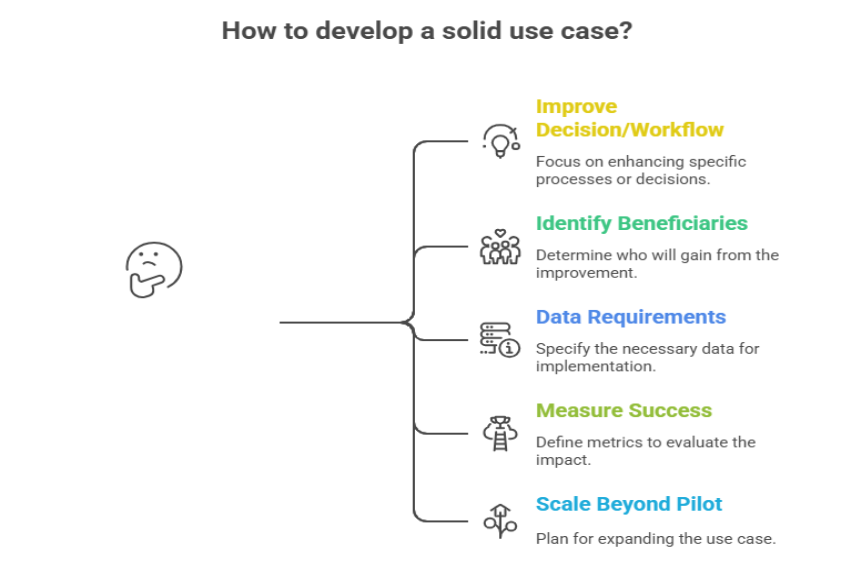
At a minimum, a solid use case answers five questions.
- What decision or workflow are we trying to improve
- Who benefits from that improvement
- What data is required to make the improvement real
- How will we measure success in business terms
- How will this scale beyond a single team or pilot
- It is helpful to distinguish between three broad categories of AI use cases.
It is helpful to distinguish between three broad categories of AI use cases.
Automation use cases
These use case focus on replacing manual, repetitive tasks with AI driven workflows. Examples include document classification, invoice processing, or triage of customer emails. The value lens is efficiency, speed, and error reduction.
Augmentation use cases
Here AI supports humans rather than replacing them. It provides recommendations, summaries, forecasts, or risk scores that help experts make better decisions. For example, a relationship manager receives AI driven churn alerts, or a maintenance engineer receives a probability of failure score on critical equipment.
Innovation use cases
These create new capabilities that did not exist before, such as personalized product recommendations in real time or generative design suggestions. They often sit closer to the business model and require deeper cross-functional coordination.
When AI leaders talk about choosing the Right Use Case for an AI, they are really choosing among these categories and asking which of them offers the best combination of value, feasibility, and strategic fit at this moment in time.
Criteria for Choosing the Right AI Use Case
Before funding any initiative, apply a structured filter. Think of this as your investment committee checklist for How to Choose the Right Use Case for an AI.
1. Strategic value
Ask whether the use case directly advances one of your top business priorities. For example, does it support margin improvement, risk reduction, regulatory compliance, or revenue growth? If the answer is vague, that is a warning sign.
2. Economic impact and time to value
Estimate the size of the prize and how quickly you can capture it. A medium sized benefit that can be realized in six months is often better than a massive promise that requires three years of foundational work.
3. Data readiness
AI thrives on relevant, accessible, and reasonably clean data. Evaluate whether the data is:
- Available in digital form
- Accessible from the necessary systems
- Sufficiently complete and accurate for the task
If a use case requires data that does not exist, or is locked across multiple silos with complex governance, that use case may belong at a later stage on the roadmap.
4. Technical feasibility
Ask whether proven techniques exist for this type of problem. Some challenges are well understood, such as demand forecasting or anomaly detection. Others sit at the frontier and carry higher technical risk. Matching ambition to your current maturity is critical when youchoose the Right Use Case for an AI.
5. Operational fit
The best models fail if they cannot integrate into business workflows. Consider whether there are clear points where AI outputs will be consumed and acted upon, and whether process owners are ready to adapt.
6. Risk and compliance
For sectors such as banking and healthcare, the risk lens is central.Hence, it is essential to evaluate potential regulatory concerns, privacy issues, and ethical considerations, and check whether you can explain model behavior in terms that regulators and customers accept.
Aligning Use Cases with Business Goals
AI should not live in a separate innovation bubble. It should be one of the tools that helps you deliver the strategy you already have.
A practical way to do this is to start with your strategic objectives, not AI capabilities. For each objective, ask three questions.
- Which decisions or processes most influence this objective
- Where do we currently experience friction, delay, or poor visibility
- Could AI realistically address those pain points, given our data and talent
For example:
- If a manufacturer wants to improve asset uptime, predictive maintenance becomes a natural candidate. The link to strategy is explicit, not inferred.
- If a bank wants to strengthen customer trust, explainable AI for credit decisions or fraud monitoring becomes more relevant than purely experimental generative interfaces.
- If a logistics provider focuses on sustainability, AI models for optimized routing and load planning directly support emissions reduction and cost savings together.
The key is to embed AI thinking into your existing portfolio governance. When leadership teams review priority programs, ask how AI can support them rather than launching a separate AI agenda in isolation.
This is where choosing the Right Use Case for an AI intersects with organizational design. Use cases that align with funded programs and accountable sponsors have a far higher chance of sustaining attention and investment.
World Examples of Successful AI Use Cases
Looking at real industries helps ground the theory. The following examples show how focused use cases create compounding value over time.
Manufacturing
In factories, AI is used to predict equipment failure, detect defects in real time through computer vision, and fine tune process parameters for yield improvement. These use cases reduce downtime, scrap, and rework. A deeper exploration of such scenarios is available in AI use cases in manufacturing.
AI agents in business operations
Modern AI agents act as workflow coordinators that call multiple systems, follow policies, and assist employees with contextual decisions. They can handle tasks such as ticket resolution, knowledge retrieval, or guided troubleshooting. You can see more detail in AI agents and business use cases.
BFSI sectors
Banks and insurers use AI for real time fraud detection, smarter underwriting, claim automation, and personalized financial advice. These applications directly affect risk and revenue. Explore real scenarios in AI applications in BFSI sector.
Construction industry
Construction organizations use AI for safety risk detection from images, schedule risk prediction, and cost variance analysis. These use cases address project delays and overruns that have tangible financial impact. Learn more in AI use cases in construction industry.
Logistics and supply chain
Here AI helps with demand forecasting, route optimization, warehouse automation, and real time supply chain visibility. These scenarios improve service levels and reduce both operating costs and environmental impact. Additional examples are available in AI in logistics and supply chain optimization.
Across all these industries, the pattern is similar. Leaders did not start with a generic goal like using AI everywhere. They made disciplined choices about specific use cases and then scaled from there.
Mistakes to Avoid When Choosing an AI Use Case
Several recurring pitfalls can derail even the most enthusiastic AI program. When you think about How to Choose the Right Use Case for an AI, it is just as important to know what to avoid.
Chasing novelty over value
It is tempting to pick use cases that are exciting in demonstrations but marginal in business impact. Over time, this erodes trust in the AI program. Always ask how the use case will show up in financial metrics, customer experience, or risk indicators.
Underestimating data work
Many leaders approve a use case assuming the data is ready, only to discover months of integration and cleansing work. Treat data readiness as a first class criterion, not a detail to figure out later.
Ignoring change management
If the people who must use AI outputs are not involved early, adoption suffers. For augmentation use cases especially, the shift in decision style can be significant. Business users need training, transparency, and feedback loops.
Fragmented governance
Scattered experiments in different business units can lead to duplicated effort and conflicting models. Establish clear ownership for reuse, standards, and shared components.
No exit criteria
Without predefined checkpoints, weak use cases linger. Define what success looks like, and also when to stop and redirect resources. That discipline is a sign of maturity, not failure.
Step by Step Framework to Select the Right AI Use Case
Here is a practical framework you can use as a leadership team when you are choosing the Right Use Case for an AI among many compelling options.
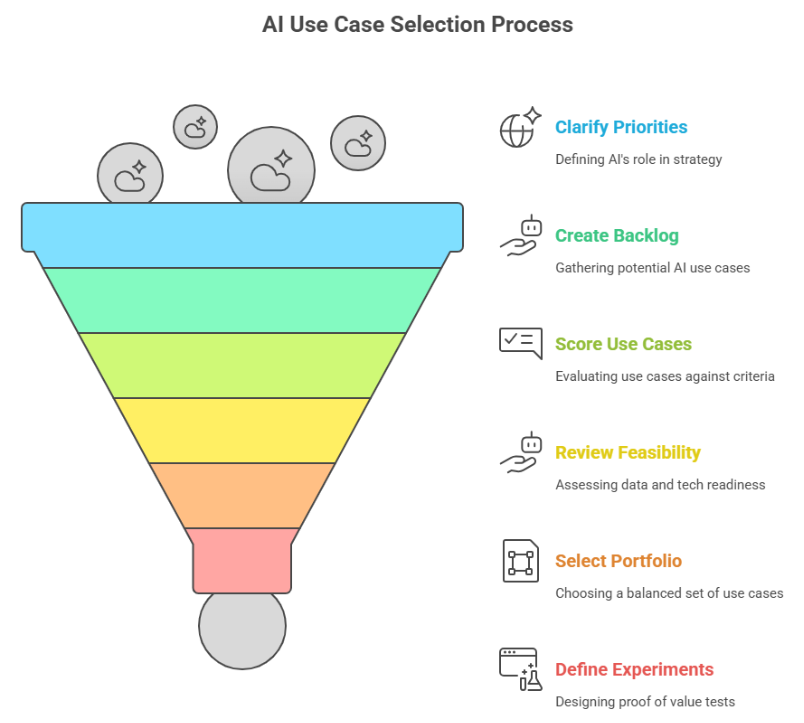
Step one: Clarify strategic priorities and constraints
Revisit your current strategy, major initiatives, and budget constraints. Agree on what you want AI to support in the next twelve to eighteen months. You are not deciding every future AI investment, only the next wave.
Step two: Create a structured use case backlog
Collect candidate use cases from business units, operations, product teams, and technology groups. Ask them to submit a simple template that includes problem description, expected value, required data, and key stakeholders.
Step three: Score each use case using a common rubric
Define scoring bands for value, feasibility, data readiness, urgency, and risk. Use consistent criteria so that a use case in supply chain can be compared fairly with one in marketing or finance.
Step four: Perform a quick data and tech feasibility review
For the highest scoring use cases, ask architects and data leaders to validate assumptions. Confirm that data exists, that access is realistic, and that the necessary tools or platforms are available or can be acquired in a reasonable time frame.
Step five: Select a balanced portfolio
Instead of betting everything on one flagship initiative, select a small portfolio. For example, one or two automation use cases with quick payback, one augmentation use case in a visible function, and one innovation use case that aligns with long term strategy. This mix helps you learn across different patterns while keeping risk manageable.
Step six: Define proof of value experiments
For each chosen use case, design a proof of value that can run in a limited environment with clear metrics and timeline. The objective is not to build the final architecture but to answer whether the use case delivers the promised benefit in a realistic setting.
Step seven: Decide to scale, pivot, or stop
At the end of the proof of value, review outcomes against the original success criteria. If the results are strong and the path to scale is clear, move to industrialization. If the value is weaker than expected or the data challenges are larger than anticipated, either pivot the design or stop and redirect effort to other candidates.
By following this framework consistently, AI leaders can show that How to Choose the Right Use Case for an AI is not guesswork but a repeatable management discipline.
Tools and Resources to Help You Evaluate AI Use Cases
Several categories of tools and resources can support your evaluation and selection journey.
Analytics and data profiling tools
Business intelligence and data catalog platforms help you quickly understand source systems, data quality, and lineage. This shortens the feasibility assessment and reveals hidden constraints early.
Value modelling templates
Many organizations create internal templates that translate improvements in time, accuracy, or conversion into financial impact. Standard models help compare use cases across domains using a common language.
AI governance and risk frameworks
Frameworks for responsible AI, model transparency, and monitoring ensure that use cases are not only valuable but also compliant and trustworthy. Having these guardrails in place gives business leaders more confidence to back ambitious ideas.
Case study libraries
Internal case studies from your own pilots, combined with external references, provide a reality check. When you see how peers use AI in manufacturing, services, BFSI, construction, or logistics, you get a clearer sense of what is realistic and what remains experimental.
Bringing these tools together turns selection into a structured, evidence-based process rather than an argument among opinions.
Conclusion
When organizations talk about AI strategy, the discussion often drifts toward platforms, models, or talent. These are important, yet the real advantage sits in selecting the Right Use Case for an AI. The right use case creates momentum, builds trust, and funds the next wave of innovation. The wrong one consumes energy, creates scepticism, and delays progress.
To Choose the Right Use Case for an AI, AI leaders must think like portfolio managers. Start from business goals, define clear criteria, respect the reality of data and operations, and be willing to end projects that do not deliver. Combine quick win use cases with a few strategic bets, and you will create both immediate impact and a foundation for long-term advantage.
The enterprises that thrive will be those that treat AI not as a magic overlay, but as a disciplined capability that is aimed precisely where it matters most.
However, if you’re still struggling to get access to the right AI use case that aligns with your business goals, Quinnox AI (QAI) Studio can help offering 70+ real AI use cases to help you make informed decisions that drive tangible benefits.
FAQs
Small businesses frequently use AI for customer support through chat systems, automated marketing, and inventory forecasting. These use cases provide immediate value with limited implementation complexity.
AI is appropriate when a business has repetitive tasks, decision processes that rely on patterns in data, or opportunities to improve prediction and personalization. If clear business challenges exist and data is available, AI can be a strong fit.
Not always. Many platforms include built in tools that make AI accessible without deep technical expertise. However, complex or large-scale use cases benefit significantly from data science involvement.
AI can process unstructured data such as text, images, or audio. The key requirement is proper preparation. If data is incomplete, enrichment or collection efforts may be necessary before modelling begins.