Accelerate IT operations with AI-driven Automation
Automation in IT operations enable agility, resilience, and operational excellence, paving the way for organizations to adapt swiftly to changing environments, deliver superior services, and achieve sustainable success in today's dynamic digital landscape.
Driving Innovation with Next-gen Application Management
Next-generation application management fueled by AIOps is revolutionizing how organizations monitor performance, modernize applications, and manage the entire application lifecycle.
AI-powered Analytics: Transforming Data into Actionable Insights
AIOps and analytics foster a culture of continuous improvement by providing organizations with actionable intelligence to optimize workflows, enhance service quality, and align IT operations with business goals.
As enterprises accelerate digital transformation, many discover that their technology initiatives stall not because of strategy, but because of aging application portfolios. Legacy systems built decades ago carry technical debt, brittle architectures, and tightly coupled code that slow innovation, inflate maintenance costs, and increase operational risk.
According to Precedence Research, the global application modernization services market size, which includes refactoring, alongside replatforming, re-architecting, and other modernization techniques, is forecasted to surge from roughly $24.32 bn in 2025 to approximately $98.38 bn by 2034, growing at a compound annual growth rate (CAGR) of ~16.8% as organizations modernize mission-critical systems.
Application refactoring – a focused modernization technique – has emerged as one of the most practical ways to modernize systems incrementally, improving performance, scalability, and maintainability without disrupting business functionality. Unlike full rewrites, refactoring allows organizations to evolve applications responsibly while continuing day-to-day operations.
This guide explains what application refactoring is, how to refactor applications effectively, and when refactoring makes strategic sense, especially in the context of cloud and modernization initiatives.
What Is Application Refactoring?
Application refactoring is the process of improving an application’s internal structure without changing its external behavior. The goal is to make the application easier to understand, maintain, scale, and extend – while preserving existing business logic.
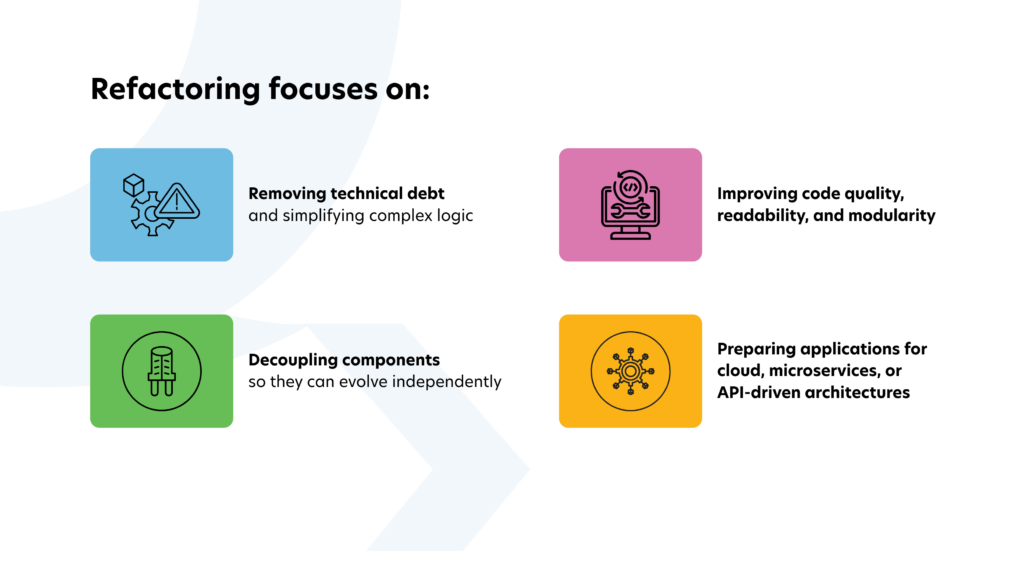
It is often a foundational step within broader legacy application modernization efforts, enabling organizations to modernize incrementally rather than through high-risk transformations.
Why Refactoring Matters: The Business Value
When done strategically, application refactoring delivers both technical and business value.

1. Faster Feature Delivery and Agility
Refactored code is easier to understand and modify. Development teams can ship enhancements with confidence and speed because dependencies are clear and modular.
2. Reduced Maintenance Costs
Technical debt – the accumulated cost of poor or outdated code – drives support costs. Refactoring reduces complexity, resulting in fewer defects and lower operational overhead.
Gartner estimates that 40% of enterprise systems are well past their end-of-life, no longer supported by vendors, and dangerously brittle, leading to operational inefficiencies and technical debt.
3. Better Performance and Scalability
By decoupling and optimizing critical components, refactored apps perform more reliably under load and scale more cost-effectively, especially in cloud environments.
4. Cloud-Readiness
Refactoring is one of the recommended approaches in cloud modernization frameworks (e.g., Microsoft’s “6 Rs”) because it preserves business logic while enabling cloud-native patterns like microservices and containerization.
5. Future-Proofing & Integration Potential
Applications with clean architecture and modular components can integrate more easily with emerging technologies – including artificial intelligence, automation, observability tooling, and platform APIs – preserving competitive advantage. For many organizations, refactoring acts as the bridge between existing systems and long-term application modernization strategy.
When Should You Refactor an Application?
Not every application requires refactoring. The decision should be guided by both technical health and business priorities.
Refactoring is a strong option when:
- Feature delivery is slowing due to fragile or complex code
- Cloud adoption is blocked by monolithic or tightly coupled design
- Maintenance costs are rising faster than business value
- Reliability, security, or scalability issues are recurring
- The application still supports critical business processes
When not to choose refactoring: When the application’s functionality is no longer relevant, or when a replace-or-buy option delivers faster value. In many cases, refactoring becomes a stepping stone within broader legacy modernization initiatives.
How to Refactor Applications: Step-by-Step Process
A disciplined approach is essential to reduce risk and maximize outcomes. Here’s a practical roadmap:
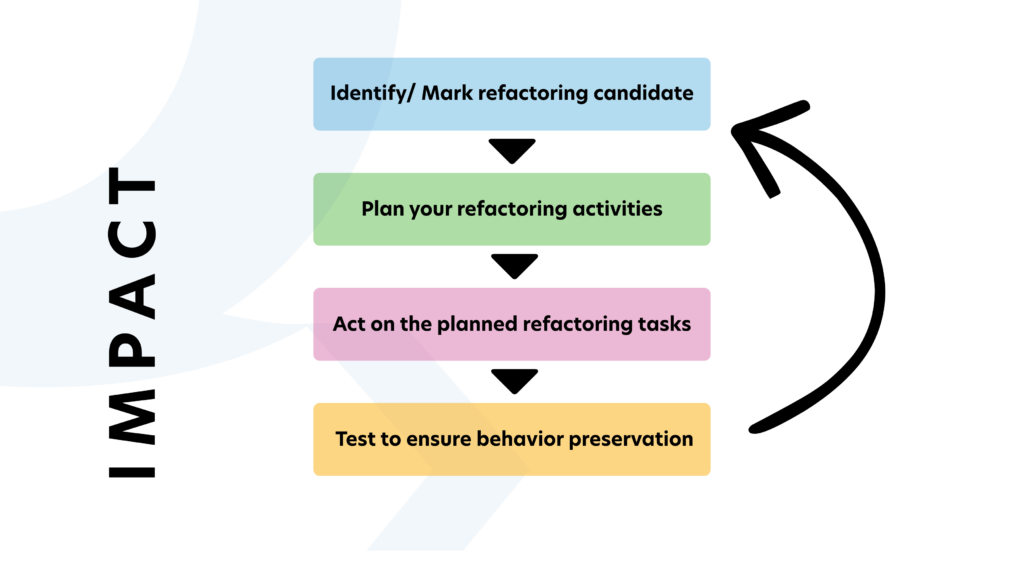
1. Assess the application landscape: identify dependencies, integration points, usage patterns, and risk areas. Understand how the application supports business workflows.
2. Define clear objectives: align refactoring goals with measurable outcomes such as faster releases, improved uptime, or reduced operational effort.
3. Prioritize refactoring candidates: focus on components that deliver the highest business value with manageable risk.
4. Establish quality and testing safeguards: ensure functional behavior remains unchanged through automated testing and validation.
5. Refactor incrementally: apply small, controlled changes rather than large-scale transformations.
6. Monitor and stabilize: track performance, reliability, and user impact after each change, with rollback options in place.
This structured approach ensures refactoring supports a sustainable guide to application modernization roadmap rather than becoming a one-off clean-up exercise.
Common Application Refactoring Patterns
Refactoring often follows well-established patterns that reduce risk while improving structure.
Common patterns include:
- Modularization: Large, tightly coupled codebases are broken into smaller, well-defined modules with clear responsibilities. This improves maintainability, supports parallel development, and simplifies scaling.
- Strangler Pattern: Instead of replacing legacy systems outright, new functionality is built alongside existing systems. Over time, legacy components are retired as modern services take over – minimizing disruption.
- Layer Separation: Separating presentation, business logic, and data access layers enables independent evolution, easier testing, and clearer ownership.
- API Stabilization: By creating stable, well-defined interfaces, teams can refactor internal logic without breaking consumers. This is critical in ecosystems with multiple dependent systems or partners.
These patterns are widely used in legacy modernization examples, particularly when modernizing mission-critical systems.
Challenges in Application Refactoring
Despite its benefits, application refactoring introduces real challenges if not managed carefully. Understanding these challenges upfront helps organizations plan realistically and avoid stalled or abandoned modernization efforts.

Insufficient test coverage
Many legacy applications lack robust automated testing, making refactoring risky. The World Quality Report highlights that a large percentage of enterprises still struggle to implement mature test automation due to legacy complexity, increasing the likelihood of regressions during structural changes.
Difficulty estimating effort and timelines
Refactoring effort is difficult to estimate because legacy codebases often contain undocumented logic and hidden complexity. McKinsey research shows that nearly 70% of digital transformation initiatives fail to meet objectives, frequently due to underestimated scope and execution challenges.
Resistance from teams focused solely on feature delivery
Refactoring competes directly with feature delivery for time and resources. Under pressure to ship new functionality, teams may deprioritize structural improvements. Gartner identifies delivery pressure as a primary driver of growing technical debt, even when organizations recognize its long-term impact.
Hidden dependencies uncovered late in the process
Years of organic growth often leave legacy systems with undocumented and tightly coupled dependencies. Industry estimates suggest up to 70% of legacy dependencies are undocumented, increasing refactoring risk. When these surface late, they can force rework and disrupt timelines.
Balancing short-term delivery pressure with long-term modernization goals
Refactoring delivers long-term value but often loses to short-term delivery goals. McKinsey estimates that 20–40% of enterprise IT estate value is tied up in technical debt, directly impacting speed, cost, and innovation if not addressed systematically.
Addressing these challenges requires strong governance and alignment with broader application modernization trends shaping enterprise IT.
Best Practices for Successful Refactoring
Organizations that succeed with refactoring follow a few consistent principles:
- Refactoring should be driven by measurable business goals such as faster release cycles, improved reliability, reduced incidents, or lower operating costs. When outcomes are clearly defined, refactoring is easier to prioritize and justify beyond pure code quality improvements.
- Successful teams view refactoring as a continuous engineering practice rather than a one-time cleanup exercise. Embedding it into everyday development prevents technical debt from accumulating and keeps applications adaptable over time.
- Breaking refactoring into small, focused changes reduces risk and makes progress visible. Incremental improvements allow teams to learn as they go while continuing to deliver features without disruption.
- Automated testing and observability ensure refactoring does not alter application behavior or degrade performance. These safeguards provide confidence, enable faster changes, and help teams quickly detect and resolve issues.
- Refactoring should support broader modernization goals such as cloud adoption, scalability, and integration readiness. When aligned with the overall strategy, refactoring accelerates transformation rather than creating isolated technical improvements.
Embedding refactoring into regular delivery cycles ensures modernization progresses steadily, improving application health without interrupting business operations.
If that sounds like a lot of work, it is! Platforms like Qinfinite offer AI-powered application modernization, making enterprise adoption faster and more effective.
Conclusion
Application refactoring is a critical capability for enterprises navigating cloud adoption, modernization, and digital growth. By improving application structure without changing functionality, refactoring enables organizations to evolve systems safely and sustainably.
When aligned with legacy modernization goals and executed incrementally, refactoring becomes more than a technical exercise – it becomes a strategic enabler for long-term resilience and innovation.
At Quinnox, refactoring is approached not as isolated code improvement, but as a core pillar of application modernization. By combining deep engineering expertise, modernization frameworks, and AI-enabled acceleration, Quinnox helps enterprises identify the right refactoring opportunities, reduce risk, and deliver measurable business outcomes, ensuring modernization progresses steadily without slowing innovation or operations.

The Quinnox Editorial Team is a collaborative group of technologists, consultants, and industry experts passionate about digital innovation. We’re dedicated to sharing practical insights, trends, and thought leadership across digital transformation, cloud, data & AI, automation, enterprise platforms, and modern engineering. Drawing from real-world experience across industries, we publish clear, actionable perspectives that help organizations navigate complex technology landscapes. Our goal is to deliver trusted, easy-to-understand content that enables smarter decisions, accelerates innovation, and drives measurable business outcomes.
FAQs About Application Refactoring
No. Refactoring improves internal structure while preserving functionality, whereas rewriting replaces large portions of the application.
Refactoring changes the internal design of the application. Replatforming moves the application to a new environment with minimal code changes.
Yes. Application refactoring for cloud is a common approach to prepare legacy systems for scalability, resilience, and cloud-native services.
Timelines vary by scope, but most organizations deliver value incrementally over weeks or months rather than through long, disruptive projects.