Accelerate IT operations with AI-driven Automation
Automation in IT operations enable agility, resilience, and operational excellence, paving the way for organizations to adapt swiftly to changing environments, deliver superior services, and achieve sustainable success in today's dynamic digital landscape.
Driving Innovation with Next-gen Application Management
Next-generation application management fueled by AIOps is revolutionizing how organizations monitor performance, modernize applications, and manage the entire application lifecycle.
AI-powered Analytics: Transforming Data into Actionable Insights
AIOps and analytics foster a culture of continuous improvement by providing organizations with actionable intelligence to optimize workflows, enhance service quality, and align IT operations with business goals.
Introduction
Enterprise technology environments have expanded at an extraordinary pace over the last decade. Business teams continuously introduce new digital tools to improve productivity, enhance customer engagement, and accelerate decision making. While this rapid adoption supports innovation, it also creates unintended complexity. Organizations often find themselves managing hundreds or even thousands of applications, many of which overlap in functionality, operate on outdated infrastructure, or consume disproportionate maintenance budgets.
This growing complexity rarely becomes visible overnight. Instead, it accumulates gradually until leaders begin to notice rising operational costs, slower modernization initiatives, and increasing security or compliance risks. At that point, the challenge is not simply technical. It becomes strategic. Leaders must determine which applications truly support business outcomes and which ones quietly limit progress.
This is where application portfolio management becomes essential. Rather than treating applications as isolated systems, APM provides a structured, enterprise level view of value, cost, risk, and modernization readiness. It enables organizations to make informed investment decisions, reduce inefficiencies, and align technology strategy with long-term business priorities.
What Is Application Portfolio Management
Application portfolio management is a structured discipline used to evaluate, govern, and optimize the full landscape of enterprise applications. It provides comprehensive visibility into how applications perform from both business and technical perspectives, including usage patterns, operational costs, architectural health, and strategic relevance.
Instead of managing applications individually, APM treats them as a coordinated portfolio similar to financial assets. This portfolio mindset allows leaders to balance investment, risk, and return across the entire technology ecosystem. Some applications require continued investment and innovation. Others may need modernization, consolidation, or retirement.
At its core, APM helps organizations answer several critical questions:
- Which applications generate meaningful business value
- Which systems introduce operational, financial, or security risk
- Where modernization funding should be prioritized
- How technology investments align with enterprise strategy
Without this level of visibility, modernization programs often become fragmented and expensive. With APM, decision-making becomes structured, evidence based and closely aligned with measurable outcomes.
Key Components of Application Portfolio Management
Successful application portfolio management depends on multiple foundational capabilities working together to create transparency and governance. Here are the key components to consider:
1. Comprehensive Application Inventory
The first requirement is a complete and continuously updated inventory of applications across all business units. This inventory should capture ownership, functionality, integrations, infrastructure dependencies, lifecycle stage, and support status. Without an accurate inventory, meaningful governance is impossible.
2. Application Portfolio Assessment
A detailed application portfolio assessment evaluates each system using consistent criteria such as business criticality, scalability, security posture, compliance alignment, user adoption, and total cost of ownership. This structured evaluation replaces subjective assumptions with quantifiable insight, enabling confident executive decisions.
3. Governance and Decision Frameworks
Strong governance ensures that application related decisions remain consistent across departments. Standardized scoring models, review cycles, and approval mechanisms prevent uncontrolled growth of redundant or low value applications.
4. Roadmap Alignment
Insights from APM must directly inform transformation initiatives such as an application modernization roadmap. When modernization priorities are aligned with portfolio intelligence, organizations invest in the systems that deliver the highest strategic return rather than pursuing disconnected upgrades.
Application Portfolio Management Frameworks
Enterprises often rely on proven analytical frameworks to operationalize APM in a repeatable and scalable manner.
1. TIME Classification Model
The TIME model categorizes applications into tolerate, invest, migrate, or eliminate. This classification simplifies executive decision-making and accelerates prioritization by clearly identifying which systems deserve funding and which should be retired.
2. Gartner Pace Layering
Pace layering groups applications into systems of record, systems of differentiation, and systems of innovation. Each layer evolves at a different speed and therefore requires a distinct investment and modernization strategy. This layered view prevents overinvestment in stable systems while enabling rapid innovation where it matters most.
3. Value Versus Complexity Matrix
Plotting applications based on business value and technical complexity reveals modernization opportunities at a glance. Leaders can quickly identify low complexity, high value candidates for rapid enhancement as well as high complexity, low value systems that should be retired.
Framework driven analysis removes ambiguity and introduces strategic clarity across the application landscape.
Application Portfolio Management vs IT Portfolio Management
These two concepts are closely connected, yet they serve different strategic purposes within the enterprise technology ecosystem. Understanding the distinction is essential for business leaders who must govern technology investments, prioritize modernization, and ensure measurable return from digital initiatives.
Application portfolio management concentrates specifically on software applications and their full lifecycle. It evaluates how each application contributes to business capability, customer experience, operational efficiency, and long-term innovation. This includes assessing technical health, scalability, integration complexity, user adoption, security posture, and total cost of ownership.
The primary objective of APM is to determine whether an application should be retained, modernized, replaced, consolidated, or retired based on clear business value and risk insight.
IT portfolio management, by contrast, operates at a broader and financial governance-oriented level. It encompasses the complete spectrum of enterprise technology investments, including:
- Infrastructure platforms such as data centres and cloud environments
- Hardware assets and endpoint ecosystems
- Network architecture and connectivity services
- Cybersecurity controls and compliance tooling
- Vendor contracts, licensing models, and managed services
While APM answers the question, “Are we running the right applications?”
IT portfolio management answers a wider question, “Are we investing in the right technology capabilities overall?”
Another important difference lies in decision cadence and stakeholders. APM decisions are often continuous and operational, involving product owners, enterprise architects, and modernization leaders who regularly evaluate application relevance. IT portfolio management decisions tend to align with budgeting cycles, capital planning, and executive governance, engaging CIOs, CFOs, and procurement leadership.
In practical terms, APM functions as a strategic layer within IT portfolio management, translating enterprise technology funding into application-level outcomes that drive business value.
When organizations integrate both perspectives effectively, they gain clearer governance, stronger cost control, and a more coherent path toward modernization and digital transformation.
Application Portfolio Rationalization
Application portfolio rationalization is one of the most valuable outcomes of APM. It involves identifying redundant, obsolete, or underutilized systems and consolidating overlapping capabilities.
Organizations frequently discover that multiple applications perform similar functions or that legacy platforms consume significant resources while delivering minimal value. Rationalization addresses these inefficiencies and produces tangible benefits:
- Reduced operating and licensing costs
- Lower cybersecurity and compliance exposure
- Simplified enterprise architecture
- Faster modernization and innovation cycles
Rationalization also prepares applications for initiatives such as application replatforming, ensuring that modernization efforts eliminate inefficiency rather than transferring it to new environments.
How to Implement Application Portfolio Management Step by Step
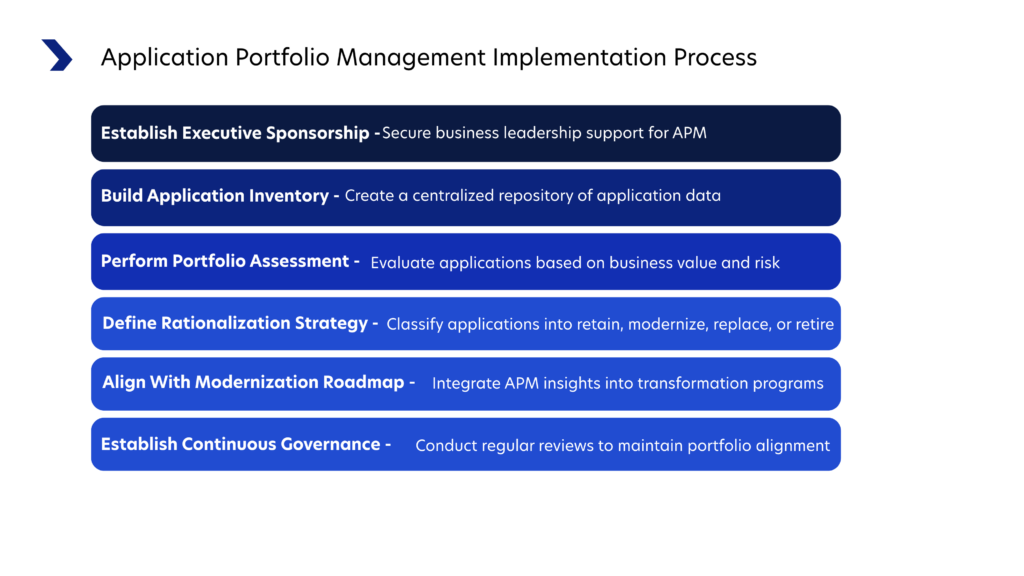
From a portfolio manager’s viewpoint, successful APM implementation follows a structured progression.
1. Step One: Establish Executive Sponsorship
Business leadership, not only IT teams, must drive APM. Executive alignment ensures funding, governance authority, and cross-functional participation.
2. Step Two: Build the Application Inventory
Create a centralized repository capturing:
- Application purpose
- Ownership
- Costs
- Integrations
- Lifecycle stage
Accuracy at this stage determines the success of all later decisions.
3. Step Three: Perform Application Portfolio Assessment
Evaluate applications using standardized scoring across business value, risk, and technical health. This creates a defensible decision baseline.
4. Step Four: Define Rationalization Strategy
Classify applications into retain, modernize, replace, or retire. Prioritize quick wins that demonstrate visible cost or efficiency gains.
5. Step Five: Align With Modernization Roadmap
Integrate APM insights into transformation programs such as cloud migration, platform engineering, and digital experience initiatives.
6. Step Six: Establish Continuous Governance
APM is not a one-time project. Quarterly or biannual reviews keep the portfolio aligned with changing business priorities.
Role of AI in Application Portfolio Management
Artificial intelligence is rapidly transforming how enterprises understand and manage complex application ecosystems. Traditional APM approaches rely heavily on manual discovery, periodic reviews, and fragmented data sources, which makes it difficult to maintain an accurate, real-time view of the application landscape. AI introduces speed, scale, and predictive intelligence into this process, enabling organizations to move from reactive management to proactive portfolio optimization.
AI powered APM platforms can deliver several high value capabilities:
- Automatically discover applications and dependencies
- Predict technical risk or failure probability
- Recommend modernization pathways
- Simulate cost optimization scenarios
- Identify unused or redundant systems
However, AI should guide decisions rather than replace leadership judgment. Strategic context, regulatory constraints, and organizational priorities still require human oversight.
As emphasized in enterprise content strategy guidance, combining expert insight with AI generated analysis produces the most trustworthy outcomes.
Common Challenges in Application Portfolio Management
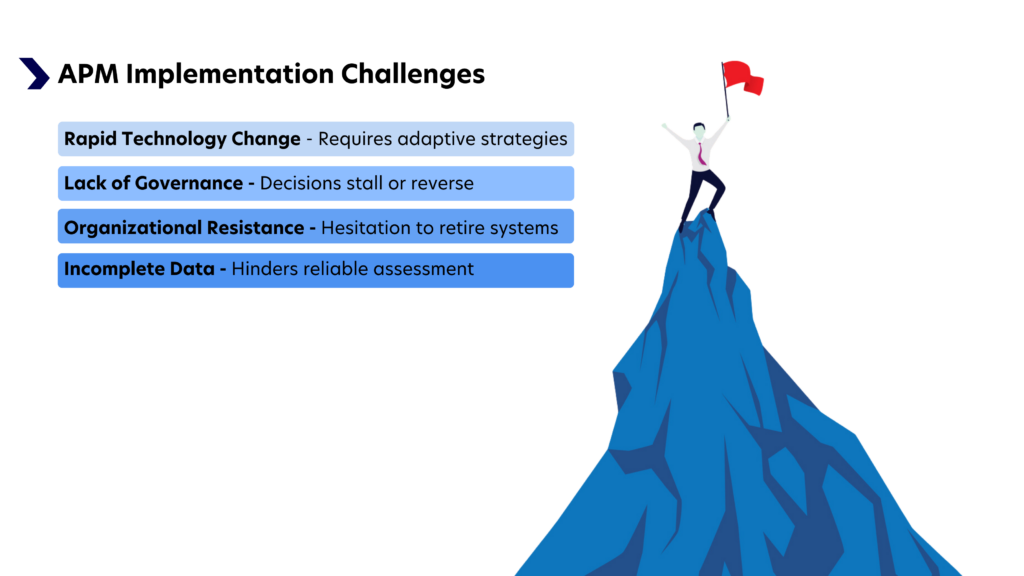
Despite clear benefits, many organizations struggle to implement APM effectively because of the following reasons:
Incomplete or Inaccurate Data
Application information is often scattered across teams, making reliable assessment difficult.
Organizational Resistance
Business units may hesitate to retire familiar systems, even when value is low.
Lack of Governance
Without executive oversight, rationalization decisions stall or reverse.
Rapid Technology Change
Cloud, AI, and platform engineering continuously shift modernization priorities, requiring adaptive APM strategies.
Recognizing these barriers early allows leaders to design stronger governance and communication plans.
Best Practices for Successful APM
Enterprises that succeed with application portfolio management share several common practices as follows:
- They position APM as a core business discipline rather than a technical clean-up effort.
- They rely on standardized, data driven decision models to maintain transparency. They prioritize rationalization initiatives that deliver measurable financial or operational impact.
- They tightly integrate APM with cloud and modernization strategies.
- They conduct continuous review cycles to keep the portfolio aligned with business evolution.
- Lastly, they combine human expertise with AI powered insight to balance speed and strategic judgment.
Conclusion
Application sprawl has evolved from a manageable inconvenience into a strategic barrier that affects cost efficiency, innovation velocity, and competitive resilience. Enterprises can no longer afford fragmented visibility into their technology landscape.
This is where Quinnox partners with enterprises to turn strategy into measurable outcomes. Through comprehensive AI-powered Application Portfolio Management services, Quinnox enables organizations to gain real-time portfolio visibility, identify rationalization opportunities, optimize costs, modernize legacy systems, and align applications to evolving business priorities. By combining data-driven insights, automation, and deep domain expertise, Quinnox helps enterprises move from reactive application oversight to proactive, value-driven portfolio governance.
Ready to simplify your application landscape and unlock greater business value? Reach our experts today to begin your APM transformation journey.

Partner Manager - Cloud & Strategic Alliances, Quinnox
FAQs About Application Modernization Roadmaps
Application portfolio management focuses on software systems, lifecycle value, and modernization strategy. IT portfolio management on the other hand includes infrastructure, hardware, networks, and broader technology investments.
Key data includes business criticality, technical architecture, integration dependencies, operating cost, security posture, user adoption, and lifecycle status.
AI can automate discovery, analysis, and recommendation. Final decisions should remain guided by business leadership and governance frameworks.
Most organizations benefit from quarterly monitoring and a detailed strategic review at least once or twice per year.
APM identifies which applications should be modernized, replatformed, retained, or retired. This ensures that cloud and modernization investments deliver measurable business value rather than simply shifting legacy complexity to new environments.