For years, ITSM has evolved through waves of improvement—standardization, virtualization, automation, and more recently, AI-assisted workflows. But each of these advancements has largely remained reactive: systems respond after a ticket is raised, after an alert is triggered, or after a disruption impact users. That is where Agentic AI in ITSM changes the equation.
Agentic AI is no longer a futuristic concept -it is rapidly becoming the backbone of next-generation enterprise operations. Gartner predicts that by 2029, agentic AI will autonomously resolve 80% of common customer service issues without human intervention, reducing operational costs by 30%. While that prediction focuses on customer service broadly, the implications for IT service desks, incident management, and employee support are equally profound.
At its core, agentic AI introduces autonomous, goal-driven systems capable of perceiving their environment, making contextual decisions, and executing multi-step actions without constant human direction. Instead of simply responding to prompts, these systems can orchestrate incident resolution, trigger workflows, communicate with stakeholders, and continuously learn from outcomes.
For IT leaders, the shift is significant. ITSM is moving from reactive ticket management toward autonomous service operations. Yet, with this transformation comes complexity. Organizations must rethink governance, accountability, data integrity, and the human-AI relationship within critical service operations. Adopting agentic AI in ITSM is not simply a technology upgrade – it is an organizational redesign.
This 2026 enterprise guide is designed to help you navigate that journey. From understanding the foundations of agentic AI to exploring practical use cases, architectural considerations, and implementation strategies, it provides a clear, structured roadmap for IT leaders looking to move beyond automation and toward true operational autonomy.
Why Traditional and Generative AI Are No Longer Enough for ITSM
Traditional AI in ITSM excels at executing predefined workflows. It can reset passwords, route incidents, or trigger alerts based on known conditions. However, it lacks the ability to adapt dynamically when situations fall outside scripted logic.
On the other hand, Generative AI marked a significant leap forward by enabling systems to understand and generate human-like language, summarize incidents, draft responses, and assist service agents in real time but it remained fundamentally assistive.
Modern ITSM demands more than efficiency at individual tasks; it requires end-to-end service intelligence. Systems must be able to detect anomalies before they escalate, diagnose root causes across interconnected environments, initiate remediation, and learn from outcomes—all without waiting for human intervention at every step.
This is where the limitations of existing approaches become clear. Traditional automation is too rigid. Generative AI is too passive. Neither is designed to operate as an autonomous, goal-driven entity within complex service ecosystems.
To meet the demands of 2026 and beyond, enterprises need a new operational model—one that moves beyond assisting humans to actively driving outcomes. This is the shift from automation to agency, and it is precisely where agentic AI begins to redefine what’s possible in ITSM.
Agentic AI vs. Generative AI vs. Traditional AI: A Comparison
| Capability | Traditional AI | Generative AI | Agentic AI |
|---|---|---|---|
| Primary Function | Rule-based automation and prediction | Content generation and conversational assistance | Autonomous planning, reasoning, and execution |
| Input Dependency | Structured inputs | Human prompts | Business goals, contextual signals, and events |
| Adaptability | Low | Moderate | High |
| Workflow Ownership | Limited to predefined tasks | Supports users with recommendations | Owns multi-step workflows end-to-end |
| Decision-Making | Deterministic | Suggestive | Contextual and dynamic |
| Learning Capability | Static models | Limited contextual memory | Continuous learning from outcomes |
| ITSM Example | Ticket routing | Ticket summarization | Autonomous incident diagnosis and resolution |
Generative AI is often conversational. Agentic AI is operational.
A generative AI assistant may summarize an incident ticket and suggest a resolution article.
An agentic AI system can detect the issue, assess severity, identify the likely root cause, notify affected stakeholders, trigger remediation workflows, escalate to the right teams if required, validate service restoration, and document the outcome automatically.
That difference is what makes agentic AI especially valuable in ITSM environments where speed, coordination, and decision quality matter.
How Agentic AI Works in an ITSM Context
In an ITSM environment, agentic AI typically operates through a combination of:
- Large language models for reasoning and communication
- Workflow orchestration engines
- Knowledge graphs and retrieval systems
- ITSM platform integrations
- Monitoring and observability tools
- Policy and governance layers
- Human approval checkpoints for high-risk actions
A typical agentic workflow may look like this:
- An event is detected through monitoring tools or an employee request.
- The AI agent gathers contextual data from tickets, CMDBs, logs, SLAs, and historical incidents.
- The agent determines probable root causes and identifies dependencies.
- It executes predefined actions such as restarting services, provisioning access, triggering scripts, or escalating incidents.
- The system monitors outcomes and adapts if the issue persists.
- It documents the entire process and updates knowledge repositories.
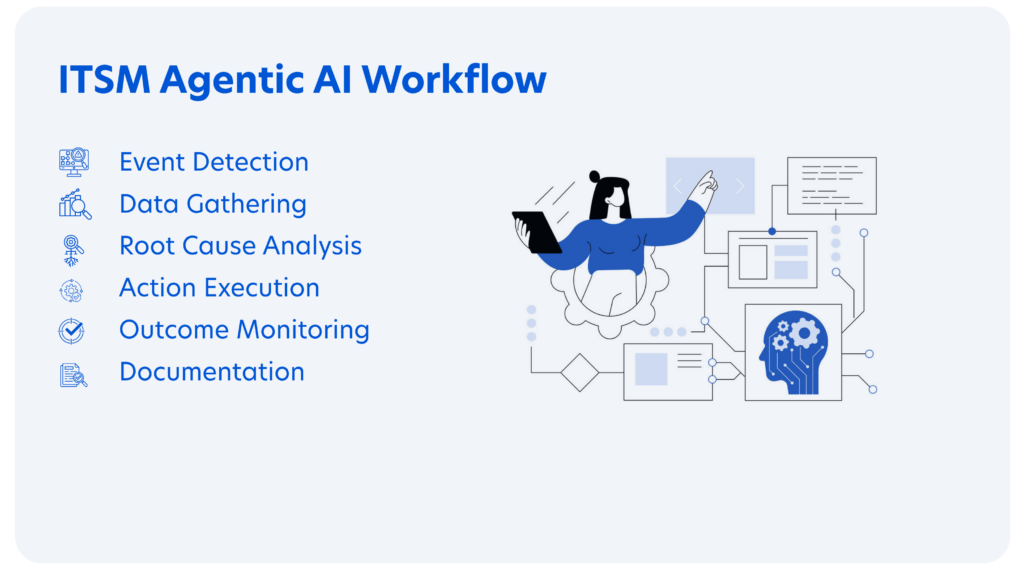
Unlike static automation, agentic systems can adjust actions dynamically based on changing conditions.
For example, if an automated remediation attempt fails, the agent can escalate to a human analyst, attach diagnostics, identify impacted users, and propose next-best actions.
Key Benefits of Agentic AI in ITSM
Faster Incident Resolution
Agentic AI can reduce mean time to detect (MTTD) and mean time to resolve (MTTR) by automating root cause analysis, triage, remediation, and escalation.
Proactive Service Management
Rather than waiting for tickets to be logged, agents can identify patterns, detect anomalies, and intervene before users are affected.
Improved Self-Service
Employees increasingly expect consumer-grade service experiences.
Agentic AI can move beyond FAQ chatbots to resolve issues end-to-end, such as resetting credentials, provisioning software access, or troubleshooting devices without analyst involvement.
Lower Operational Costs
As more repetitive workflows are automated, service desk teams can focus on complex, high-value work.
Better Decision-Making
Agentic AI can continuously analyze ticket trends, asset health, service performance, and user sentiment to help IT leaders prioritize investments and operational improvements.
Real-World Impact: Reducing Operational Costs and MTTR in Retail
A leading retail enterprise struggled with recurring outages, fragmented monitoring environments, and high service desk overhead across its IT operations landscape.
By implementing Everforth Quinnox’s Intelligent Application Management Platform, the organization was able to move from reactive issue handling to proactive, AI-driven service management.
The results were significant:
- 45% reduction in operational costs
- 95% reduction in mean time to resolution (MTTR)
- Improved visibility across applications and infrastructure
- Faster remediation of recurring incidents
- Better end-user experience through reduced downtime
This example highlights how agentic AI can help enterprises reduce service desk burden, improve operational resilience, and create a more efficient IT support model.
Agentic AI in ITSM: High-Impact Use Cases
1. Autonomous Incident Management
Agentic AI can triage incidents, correlate alerts, identify probable root causes, execute remediation workflows, and escalate only when human intervention is required.
2. Intelligent Request Fulfillment
Employees can request access, software, devices, or support in natural language. The agent can validate policies, gather approvals, execute provisioning workflows, and close the request automatically.
3. Predictive Problem Management
By analyzing historical incident patterns, infrastructure telemetry, and service dependencies, agents can identify recurring problems before they cause major outages.
4. Change Risk Analysis
Before implementing changes, agentic systems can evaluate historical change failures, identify affected dependencies, estimate business risk, and recommend safer deployment windows.
5. Knowledge Management Automation
Agentic AI can generate, update, validate, and organize knowledge articles based on resolved incidents and service desk activity.
6. Major Incident Communication
During critical outages, agents can provide stakeholders with automated updates, estimated timelines, impact assessments, and resolution status across channels.
7. Endpoint and Device Support
Agentic systems can diagnose device performance issues, recommend fixes, automate patching, and trigger endpoint remediation workflows.
How to Implement Agentic AI in ITSM: A Step-by-Step Roadmap
1. Start with High-Volume, Low-Risk Use Cases
Begin with repetitive service desk workflows such as password resets, software provisioning, ticket classification, or basic incident triage.
2. Build a Strong Data Foundation
Agentic AI depends on clean and connected data.
Organizations should unify data across:
- ITSM platforms
- CMDBs
- Knowledge bases
- Monitoring systems
- Identity platforms
- Collaboration tools
- Security systems
3. Define Governance and Guardrails
Not every action should be fully autonomous.
Establish clear policies for:
- Which workflows can be automated
- Which actions require approvals
- Escalation thresholds
- Audit trails and compliance controls
- Security and role-based access
4. Introduce Human-in-the-Loop Oversight
In the early stages, AI agents should support analysts rather than replace them.
Human validation helps build trust, reduce risk, and improve model performance over time.
5. Integrate with Existing ITSM Platforms
Agentic AI works best when embedded into existing service management ecosystems rather than deployed as a standalone layer.
6. Measure Business Outcomes
Track outcomes such as:
- MTTR reduction
- Ticket deflection rates
- First-contact resolution
- Service desk productivity
- Employee satisfaction
- Change failure rates
- Cost per ticket
McKinsey research suggests that AI could unlock trillions of dollars in long-term productivity gains, but organizations only realize value when they redesign workflows, operating models, and workforce responsibilities alongside technology adoption.
Challenges and Considerations In Adopting Agentic AI in ITSM
Despite the promise, agentic AI introduces new risks and operational considerations.
Governance and Accountability
When AI agents take autonomous actions, organizations need clear accountability models for decisions, errors, and escalations.
Security Risks
Agentic systems often require deep access across enterprise systems.
Without proper controls, over-permissioning, prompt injection, and data exposure can create significant vulnerabilities.
Security experts warn that always-on AI agents can create a large attack surface if governance, segmentation, and monitoring are not properly implemented.
Data Quality Issues
Poor CMDB hygiene, fragmented knowledge bases, and incomplete incident histories can limit the effectiveness of agentic systems.
Employee Trust and Change Resistance
IT teams may fear that AI will replace jobs or reduce human decision-making authority.
In practice, the most successful organizations position AI as a force multiplier that augments service desk analysts rather than replacing them.
Unrealistic Expectations
Many organizations underestimate the amount of process redesign required to scale agentic AI. Industry experts note that successful adoption requires business process re-engineering, centralized governance, and AI-ready operating models rather than isolated tool deployments.
How AMaS (Application Management as Software) Powers Agentic AI in ITSM
Everforth Quinnox’s AMaS (Application Management as Software), under Services as Software delivery model enables organizations to move beyond fragmented automation and toward intelligent, autonomous service operations.
Our AMaS model, recognized by HFS Research combines AI-driven orchestration, contextual intelligence, and service workflow automation to help IT teams:
- Automate repetitive service desk activities
- Accelerate incident triage and remediation
- Improve employee self-service experiences
- Enable predictive and proactive IT support
- Reduce operational overhead
- Strengthen governance and visibility across ITSM processes
Unlike isolated AI copilots that focus only on conversation or summarization, AMaS is designed to support end-to-end workflow execution.
That means organizations can move from reactive ticket handling toward autonomous service delivery while maintaining control, compliance, and human oversight where needed.
Everforth Quinnox’s experience across enterprise IT transformation, service operations, automation, and AI implementation positions it to help organizations adopt agentic AI in a practical, scalable, and outcome-driven way.
Success Stories - Improving MTTR and Ticket Handling in Banking
A leading European bank faced growing pressure on its service desk teams due to rising ticket volumes, slower incident resolution, and increasing operational complexity across legacy and modern platforms.
Using Everforth Quinnox’s AMaS model, the bank introduced AI-led incident intelligence, workflow automation, and contextual ticket handling without replacing its existing ITSM environment.
The business outcomes included:
- Significant reduction in MTTR
- Doubled ticket handling capacity
- Improved cost efficiency across service operations
- Faster identification of incident patterns and recurring issues
- Better alignment between service desk teams and business users
This case demonstrates that agentic AI does not require organizations to rip and replace existing platforms. Instead, it can work alongside current ITSM tools to drive measurable service improvements and operational scale.
Conclusion
For IT leaders, the opportunity is not simply to automate more tasks. It is to redesign service operations around autonomy, resilience, and user experience.
Organizations that begin building the right data foundations, governance models, and human oversight mechanisms today will be better positioned to scale agentic IT operations tomorrow.
As Forrester has observed, the race toward agentic service management has already begun. The enterprises that act early will be the ones that define the next generation of IT service excellence.

Head – Digital Marketing, Everforth Quinnox
FAQs
Agentic AI in ITSM refers to autonomous AI systems that can reason, plan, make decisions, and execute service management tasks with minimal human intervention.
Generative AI focuses on creating content, answering questions, and summarizing information. Agentic AI goes further by taking actions, orchestrating workflows, and owning outcomes.
Key use cases include incident management, service request fulfillment, predictive problem management, knowledge management, change risk analysis, and employee self-service.
It can be safe when organizations implement strong governance, role-based access, audit trails, human oversight, and security controls.
In most cases, agentic AI works alongside existing ITSM platforms rather than replacing them. Modern agentic AI solutions are typically integrated into tools such as ServiceNow, Jira Service Management, BMC Helix, Freshservice, and Ivanti through APIs, workflows, connectors, and orchestration layers.
The goal is not to rip and replace existing ITSM investments, but to enhance them with autonomous decision-making, workflow execution, and contextual intelligence.
AIOps is primarily focused on infrastructure monitoring, event correlation, anomaly detection, and operational insights across IT environments.
Agentic AI in ITSM extends beyond infrastructure operations into end-to-end service management workflows. It can handle employee requests, orchestrate incident resolution, manage approvals, automate communications, and execute business process actions across systems.
In many organizations, AIOps and agentic AI will work together, with AIOps identifying operational issues and agentic AI coordinating service responses.
Generative AI supports ITSM teams by generating summaries, drafting responses, creating knowledge articles, and answering user queries.
Agentic AI takes the next step by independently making decisions and executing actions. For example, a generative AI assistant may suggest how to resolve a ticket, while an agentic AI system can identify the issue, trigger remediation workflows, update stakeholders, and close the ticket automatically.
Agentic AI is unlikely to replace service desk teams entirely.
Instead, it will automate repetitive, low-complexity work such as password resets, ticket routing, access requests, and common troubleshooting tasks. Human agents will continue to play a critical role in handling exceptions, managing high-impact incidents, providing empathy in employee interactions, and making judgment-based decisions.
The more likely outcome is a shift in service desk roles toward oversight, exception handling, and strategic service improvement.
Most organizations begin to see measurable returns within six to twelve months when they start with high-volume, low-risk use cases.
Early ROI often comes from reduced ticket volumes, faster incident resolution, lower service desk costs, and improved employee self-service adoption.
Broader transformation outcomes, such as proactive service management, reduced downtime, and enterprise-wide workflow automation, typically emerge over a longer period as organizations mature their data, governance, and operating models.